
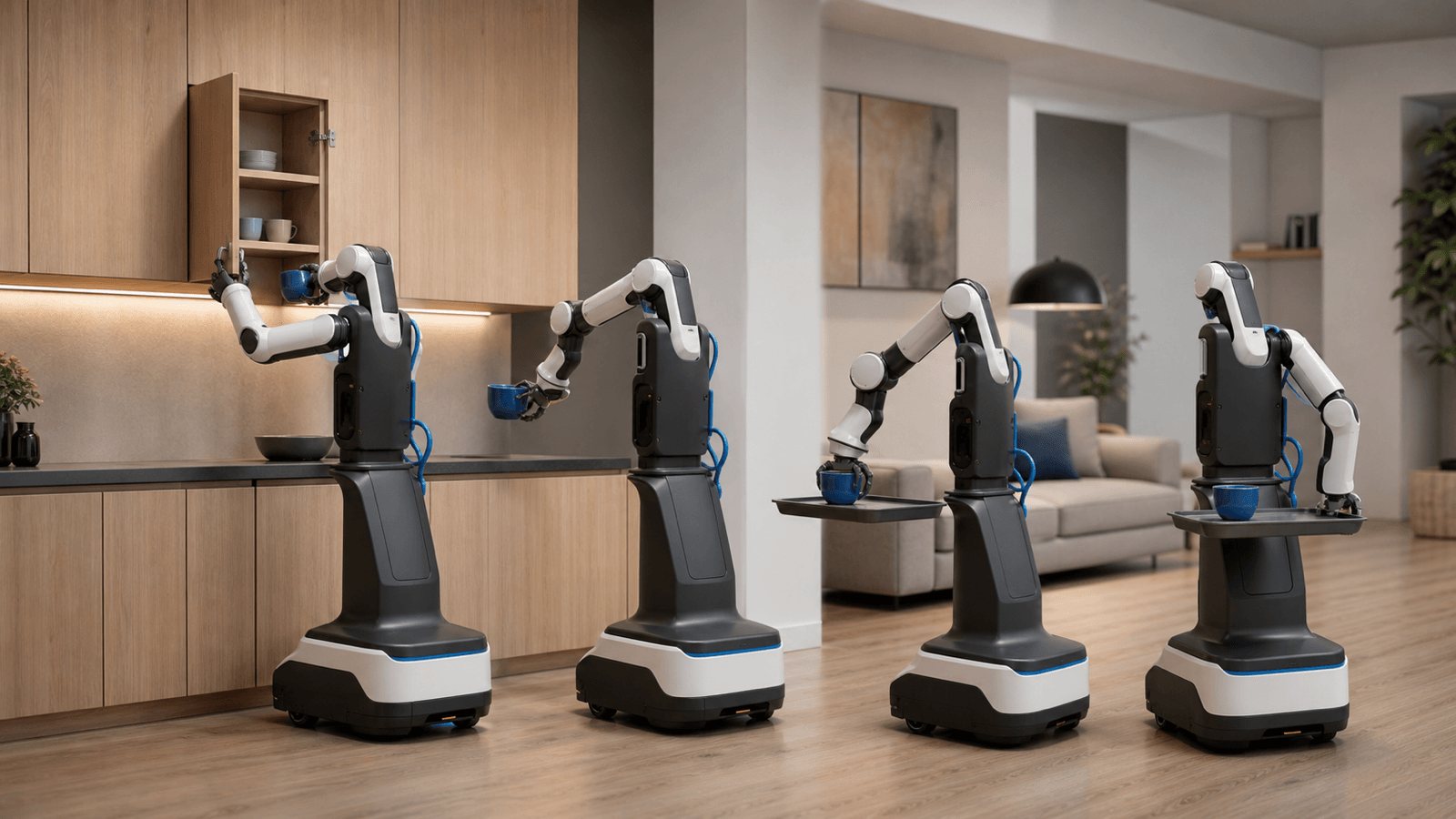
AI-generated editorial illustration. It is explanatory and does not represent measured data or a documented experiment.
1. Core conclusion
Long-horizon robot control is not solved by asking a vision-language-action model to predict a longer block of motion. As tasks grow from one grasp to a sequence of opening, retrieving, placing and closing, small errors change the state on which every later action depends. Recent systems address this by adding structure: phase-aware perception inside an end-to-end policy, a high-level planner that invokes bounded VLA tools, or steerable policies conditioned on subgoals and execution context. Each can extend useful behavior in its tested setting, but none yet demonstrates dependable multi-stage autonomy across arbitrary homes or workplaces. The decisive capability is not memory alone. It is the ability to track progress, recognize that reality diverged from the plan and recover before the next error compounds.
2. The problem
A short manipulation task can often be judged from the current image: locate the cup, move the gripper, close the fingers and lift. A long task carries history. To make a drink, a robot may need to find an appliance, open it, place an item correctly, operate a control, wait, retrieve the item and restore the workspace. The validity of every step depends on the actual outcome of the previous one. If the door opened only halfway or the object slipped to a new pose, continuing the memorized sequence can make the situation worse.
This creates several linked problems. The policy must decompose a broad goal into feasible local actions, decide when one subtask has ended, preserve relevant state across many observations and switch between gross motion and contact-rich interaction. It must also resist demonstration bias: a familiar visual scene may prompt a common action even when the current language instruction asks for something unusual. Long action chunks reduce inference overhead, but they can continue executing stale decisions after the scene changes.
The probability of full completion also falls as steps accumulate. Even if each stage succeeds most of the time, the chance that all stages succeed is lower than the reliability of any one stage. Benchmarks therefore need to report more than individual-skill success. Sequence length, subtask completion, recovery, intervention and time limits all affect whether a result represents meaningful long-horizon control.
3. How it works
Most current designs introduce hierarchy somewhere in the loop. The hierarchy may be implicit inside one network or explicit across separate models. At the lowest level, a controller converts recent camera and robot-state observations into continuous actions. Above that, the system represents progress: which phase is active, which subgoal should be achieved or which callable skill is currently responsible for execution. A slower reasoning process can then update the plan when a local unit completes or stalls.
Phase-aware policies divide a subtask into modes such as moving toward an object and physically interacting with it. Different camera views and visual cues matter in each phase. A tool-based agent instead gives a high-level vision-language model a family of bounded robot executors—grasp, open, place or rotate—and asks the executor to return progress information. A steerable generalist policy keeps a shared action model but enriches its prompt with detailed language, episode metadata, recent video or generated images of desired subgoals.
These approaches share one principle: shorten the distance between a decision and the evidence that can correct it. The model may still perform a long task, but it does so as a series of monitored commitments rather than one uninterrupted prediction. The design trade-off is where to place the boundary. More explicit modules improve inspectability and allow replanning, while a unified policy avoids brittle handoffs and may use shared representations more efficiently.
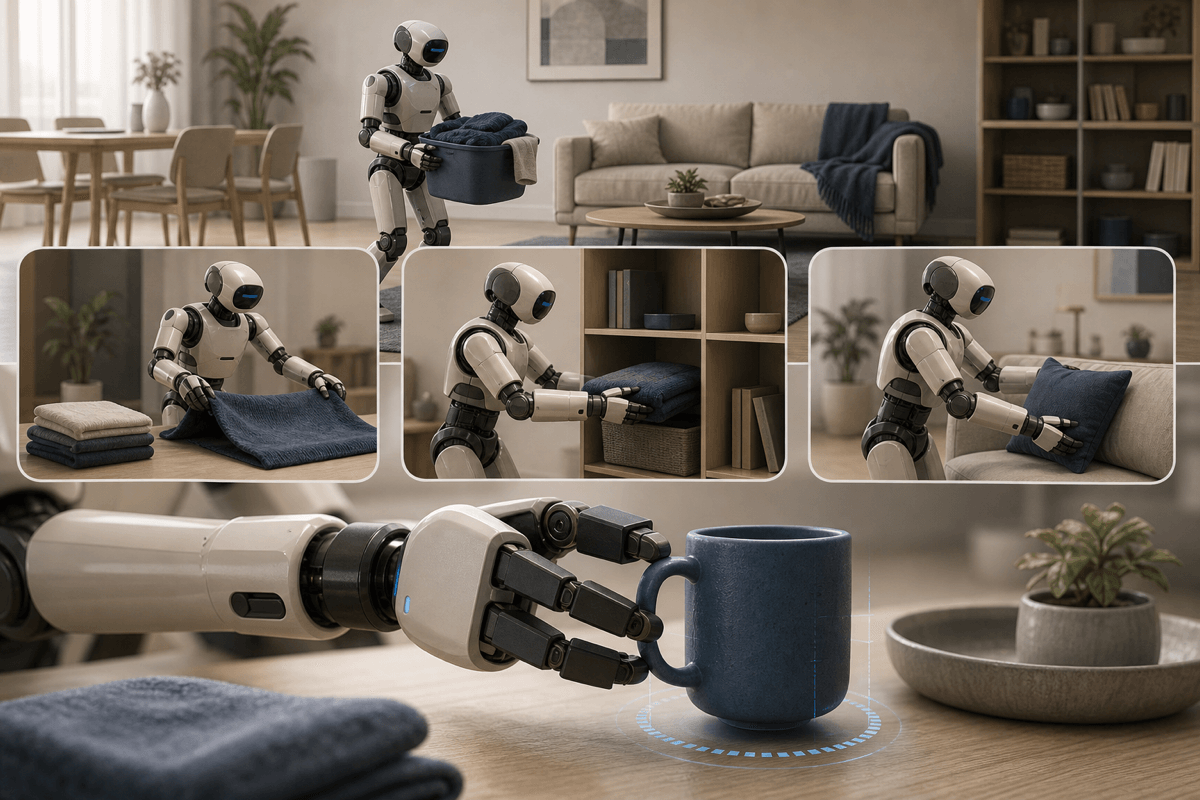
AI-generated editorial illustration. It is explanatory and does not represent measured data or a documented experiment.
4. Representative approaches
Long-VLA keeps the policy end to end but changes what it attends to. The CoRL 2025 work divides subtasks into moving and interaction phases and applies phase-aware input masking. During broader movement, the policy can emphasize scene-level information; during close interaction, it can prioritize cues relevant to precise contact. The authors also introduced L-CALVIN to evaluate longer manipulation sequences and demonstrated two physical task families, sorting and cleaning, including altered lighting and visual distractors. The appeal is architectural continuity: the method adds phase structure without replacing the VLA with a hand-built planner. Its evidence remains bounded by the authors’ benchmark, task decomposition and two real-world demonstrations.
VLAs-as-Tools makes the hierarchy explicit. A high-level vision-language model analyzes the scene, plans over time and selects a specialized VLA executor for a bounded subtask. The tool receives both a family label and a scene-grounded instruction, then returns a progress signal. Event-triggered replanning lets the high-level model intervene when execution stagnates without polling every low-level action. Tool-Aligned Post-Training aligns training segments with the same invocation unit used at runtime. In the paper’s experiments, the method improved π0.5 success by 4.8 percentage points on LIBERO-Long and 23.1 points on the selected RoboTwin setup. OpenVLA-OFT gained 35.5 points on RoboTwin. These are author-reported benchmark results, not comparisons on physical household deployment.
π0.7 treats context as a steering interface. Physical Intelligence’s model is conditioned not only on the task command but also on richer descriptions of strategy, episode metadata, observation history and optional generated subgoal images. The paper reports experiments across several robot platforms and uses language coaching to collect multi-stage behavior for previously uncollected tasks such as operating an air fryer or toaster. A learned high-level language policy can then provide the step-by-step prompts autonomously. This is less modular than a family of separately named tools, yet it still separates slower subgoal choice from continuous execution through context. The authors report that unseen tasks or unseen task–robot combinations generally remained below seen-task performance, often in the 60–80% success range rather than the greater-than-90% rates seen on familiar tasks.
5. Real-world applications
The reviewed systems target the kinds of workflows that make robots economically interesting: tidying multiple objects, operating appliances, packing, cleaning and completing sequences that cross several locations or contact modes. Long-VLA’s physical demonstrations cover sorting and kitchen cleanup. π0.7’s reported experiments include multi-stage kitchen tasks, laundry and other dexterous workflows across different robots. VLAs-as-Tools evaluates longer compositions in simulation benchmarks where a high-level agent can select and monitor local executors.
These examples should be described as research evaluations, not general commercial deployment. A task lasting several minutes in a prepared environment does not establish an unattended work shift. The system may rely on known object families, bounded initial conditions, curated language, reset procedures or hardware-specific controllers. The practical near-term use is narrower: structured work cells and pilots where task phases are known, failures are observable and a human can intervene when the recovery logic exhausts its options.
6. How it is evaluated
Long-horizon evaluation must preserve sequence structure. CALVIN’s long-horizon challenge asks a policy to complete chains of five language-specified subtasks and reports average successful sequence length as well as the share reaching each depth. Long-VLA extends the problem through L-CALVIN and reports comparisons against a base policy and prior methods, along with physical sorting and cleaning demonstrations under random locations, unseen lighting and visual distraction. The relevant question is not only final success but how far the policy progresses before failure.
VLAs-as-Tools tests both the complete agent loop and the local executor. LIBERO-Long and selected RoboTwin tasks measure long-horizon success, while Non-biased Rate measures whether a tool follows the invoked instruction instead of defaulting to dataset or scene bias. The reported 4.8- and 23.1-point gains for π0.5 compare the authors’ tool-family system with a standalone supervised baseline under their specified benchmark protocols. CALVIN_D is used as a complementary setting with existing subtask structure.
π0.7 uses a broader collection of author-designed tasks, robots and scoring rubrics. It reports instruction-following success across sequences of three to six instructions in unseen kitchens and bedrooms, task progress for partially completed workflows, and binary success where a clear final condition exists. For zero-shot shirt folding on a different bimanual embodiment, the paper reports 85.6% task progress and 80% success for π0.7 with generated subgoal conditioning, compared with 90.9% progress and 80.6% success from ten experienced teleoperators over 30 human trials. This supports a specific transfer claim under matched conditions; it does not measure general long-horizon reliability.
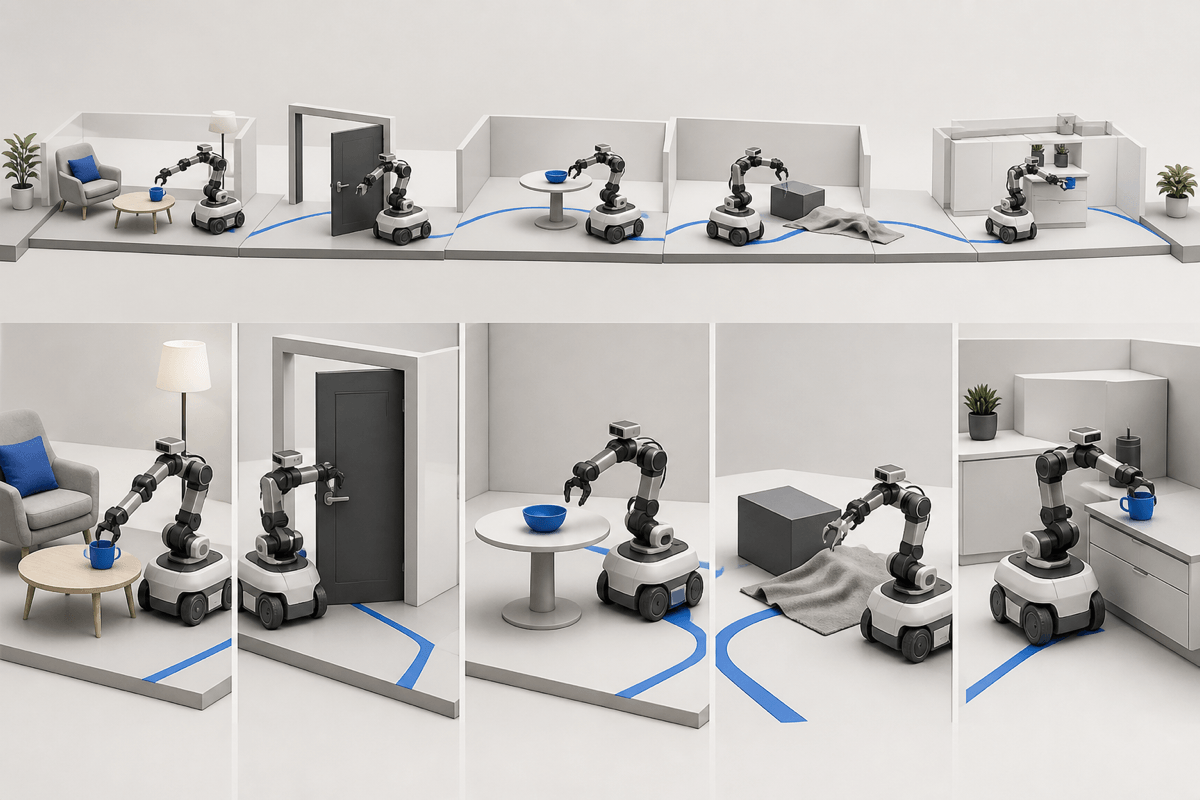
AI-generated editorial illustration. It is explanatory and does not represent measured data or a documented experiment.
7. Current limitations
Long-horizon datasets are expensive because demonstrations must remain coherent across many stages. An error early in collection can invalidate the rest of the trajectory, while rare recovery examples are especially difficult to gather. Automatic segmentation can assign the wrong phase or tool label. Explicit tool families also require definitions, training data and completion predicates for each bounded operation; a planner cannot reliably invoke a skill that the executor does not actually possess.
Progress estimation is another weak point. A robot may appear close to finishing while holding an object insecurely, or it may make useful recovery motions that look like temporary regression. High-level replanning adds latency and can misread the scene. End-to-end models avoid some interface errors but make it harder to identify why a sequence failed. Generated subgoal images can provide useful visual context while also depicting physically impossible states.
Evaluation remains fragmented. CALVIN, LIBERO, RoboTwin and company-designed physical tasks differ in embodiment, reset rules, sequence length and success predicates. Five subtasks do not represent an hour of autonomous work. Aggregate success hides the point of failure, human intervention and damage avoided only by laboratory safeguards. Long-duration operation also introduces battery limits, thermal behavior, calibration drift, object wear, network interruption and changing human activity that short research trials rarely cover.
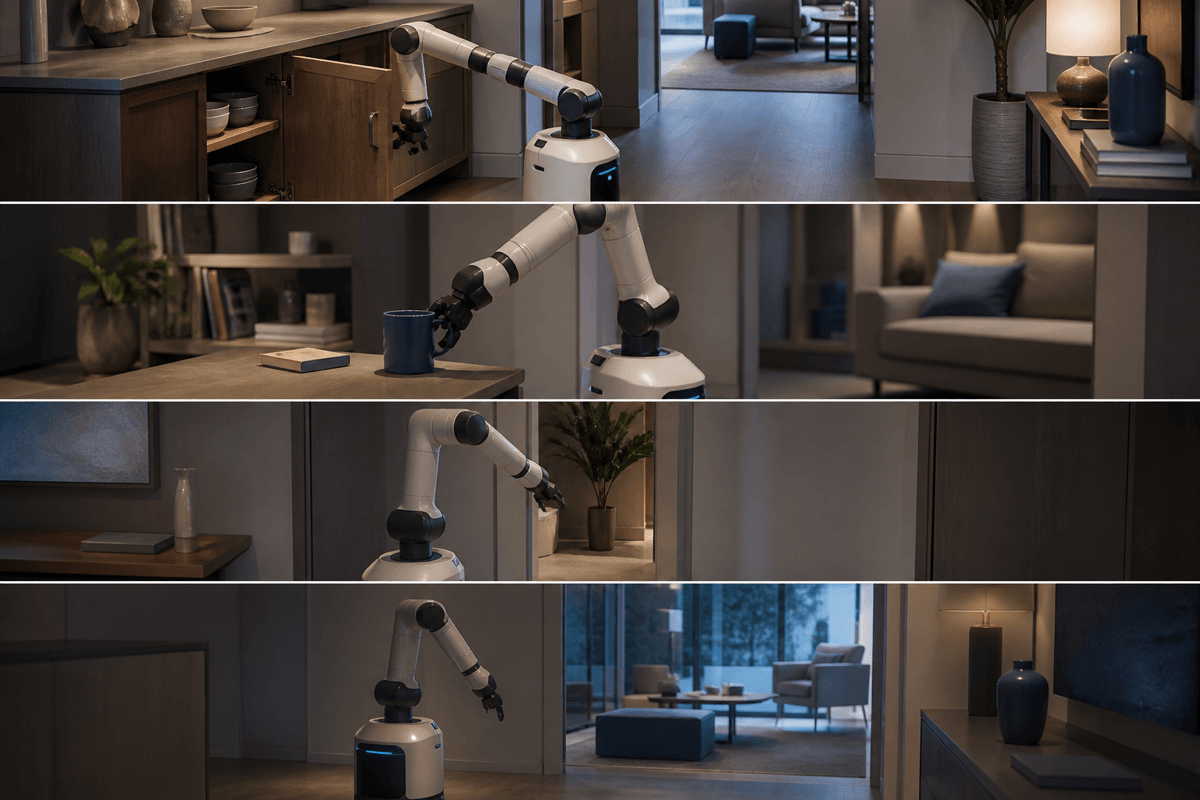
AI-generated editorial illustration. It is explanatory and does not represent measured data or a documented experiment.
8. Why it deserves attention
Long-horizon control is the bridge between an impressive skill and useful work. The field’s current shift is important because it reframes the problem from generating more actions to organizing decisions and correction. Phase signals, tool interfaces, subgoal prompts and progress feedback are different implementations of the same practical insight: a robot needs checkpoints where it can compare intention with physical reality.
Evidence of substantive progress would include longer uninterrupted trials across multiple sites, published intervention and recovery rates, evaluation on unseen task compositions, and comparisons that keep hardware and reset conditions constant. Researchers should report where sequences fail, not only whether the last predicate fires. A robot that can finish a multi-stage task sometimes is a valuable research result. A robot that knows when the task has gone off course—and can return to a valid state—is the more consequential milestone.
9. Sources & evidence
- Yiguo Fan et al., “Long-VLA: Unleashing Long-Horizon Capability of Vision Language Action Model for Robot Manipulation,” CoRL 2025, arXiv v2, 28 August 2025.
- Long-VLA authors, “Long-VLA project page,” 2025.
- Zixing Lei et al., “Towards Long-horizon Embodied Agents with Tool-Aligned Vision-Language-Action Models,” arXiv, 13 May 2026.
- Physical Intelligence et al., “π0.7: a Steerable Generalist Robotic Foundation Model with Emergent Capabilities,” arXiv v2, 24 April 2026.
- CALVIN authors, “CALVIN: A Benchmark for Language-Conditioned Policy Learning for Long-Horizon Robot Manipulation Tasks,” official repository.
All performance claims are attributed to their authors and remain limited to the reported task definitions, datasets, robots, simulators, baselines and trial protocols.
Sources — Long-horizon VLA control
-
Long-VLA: Unleashing Long-Horizon Capability of Vision Language Action Model for Robot Manipulation
- Authors: Yiguo Fan et al.
- URL: https://arxiv.org/abs/2508.19958
- Published: 2025-08-27; revised 2025-08-28
- Accessed: 2026-09-01
- Type: Primary paper
- Supports: Phase-aware input masking, moving/interaction decomposition, L-CALVIN and reported simulated and physical evaluation scope.
-
Long-VLA project page
- Institution: Long-VLA research team
- URL: https://long-vla.github.io/
- Published: 2025
- Accessed: 2026-09-01
- Type: Official project documentation
- Supports: Sorting and cleaning demonstrations, random-location evaluation, unseen lighting and visual-distraction conditions.
-
Towards Long-horizon Embodied Agents with Tool-Aligned Vision-Language-Action Models
- Authors: Zixing Lei et al.
- URL: https://arxiv.org/abs/2605.13119
- Published: 2026-05-13
- Accessed: 2026-09-01
- Type: Primary paper
- Supports: High-level VLM planner, VLA tool-family interface, progress feedback, event-triggered replanning, TAPT and reported LIBERO-Long/RoboTwin results.
-
π0.7: a Steerable Generalist Robotic Foundation Model with Emergent Capabilities
- Authors: Physical Intelligence et al.
- URL: https://arxiv.org/abs/2604.15483
- Published: 2026-04-16; revised 2026-04-24
- Accessed: 2026-09-01
- Type: Primary technical report
- Supports: Rich context conditioning, language coaching, subgoal images, multi-stage kitchen tasks, cross-embodiment evaluation and stated generalization limits.
-
CALVIN official repository
- Institution: CALVIN authors
- URL: https://github.com/mees/calvin
- Published: Original benchmark documentation maintained through access date
- Accessed: 2026-09-01
- Type: Official benchmark repository
- Supports: Five-subtask long-horizon evaluation protocol and average successful sequence length framing.