

AI-generated editorial illustration. It is explanatory and does not represent measured data or a documented experiment.
1. Core conclusion
Action tokenization is not a neutral formatting step. It decides which parts of robot motion a vision-language-action model can represent efficiently and which distinctions are blurred or lost. Frequency-based compression, learned vector codes and semantically aligned tokenizers each preserve different structure. No current method simultaneously guarantees precise reconstruction, fast generation, language alignment and transfer across robot bodies. The best tokenizer depends on the task, control frequency and policy architecture around it.
2. The problem
Language models predict discrete units: one token after another. Robot controllers usually require continuous values such as joint positions, end-effector displacement, rotation, gripper state or motor targets. A vision-language-action model must bridge those representations. It can generate continuous actions through a separate action head, or convert motion into discrete tokens that fit the same autoregressive machinery used for language.
The obvious method is to divide each action dimension into bins at every time step. A value such as a wrist rotation becomes the nearest bin index. This is simple, but high-frequency dexterous motion creates long token sequences. Treating every joint and time step separately also ignores temporal structure: many robot trajectories are smooth, and neighboring commands are strongly related.
Aggressive compression creates the opposite problem. A short token sequence is easier to predict, yet small errors can matter physically. Two trajectories that look numerically similar may place a gripper on opposite sides of a handle. Two motions that end at the same pose may express different instructions, such as pushing and wiping. Tokenization therefore has at least four competing goals: reproduce motion, shorten sequences, retain instruction-relevant meaning and work across embodiments with different action spaces.
3. How it works
A tokenizer contains an encoder and a decoder. The encoder maps an action sequence into a smaller representation; the decoder reconstructs continuous commands from that representation. Discrete tokenizers add quantization, which assigns the encoded motion to entries in a finite vocabulary. The policy predicts those entries, and the decoder converts them back into robot actions.
FAST uses a signal-processing route instead of learning the vocabulary end to end. It first transforms action chunks from time space into frequency space with the discrete cosine transform. Smooth motion concentrates information in relatively few frequency coefficients. After quantization and byte-pair encoding, recurring coefficient patterns become compact tokens. FAST+ is presented as a universal tokenizer trained on one million real robot action trajectories.
Learned tokenizers replace a fixed transform with neural compression. A vector-quantized model learns codebook entries that minimize reconstruction error. FASTer represents action chunks as single-channel images, applies a learned tokenizer called FASTerVQ and uses block-wise autoregressive decoding plus a lightweight action expert. X-Tokenizer separates coarse intent from fine detail: its first quantization level is trained to capture an action language, while deeper residual levels reconstruct precise motion.
Semantic objectives add another signal. SALT asks a frozen vision-language model to recover the episode instruction from quantized action latents. The tokenizer is rewarded not only for reproducing numbers, but also for preserving information that distinguishes action verbs. This changes the question from “Can the decoder reconstruct the trajectory?” to “Does the code still express what the robot was doing?”

AI-generated editorial illustration. It is explanatory and does not represent measured data or a documented experiment.
4. Representative approaches
FAST: fixed frequency-space compression. FAST exploits temporal smoothness with a discrete cosine transform, then quantizes and compresses the coefficients. The authors report that, with the π0 VLA, it matched diffusion-VLA performance while reducing training time by as much as five times. The approach is attractive because the tokenizer is understandable and FAST+ can be applied as a black box. Its assumptions favor smooth trajectories, and compression is not explicitly optimized for the semantic differences between instructions.
FASTer: learned spatiotemporal compression. FASTerVQ encodes an entire action chunk as an image-like representation, allowing its code to capture relationships across time and action dimensions. FASTerVLA then predicts blocks rather than only single tokens and uses a lightweight action expert. The paper reports stronger reconstruction, token utilization, inference speed and task results across simulation and real-world benchmarks. Those outcomes are author-reported across the paper’s selected settings; they do not establish that one neural codebook will transfer without loss to every robot.
SALT: language-aligned codes. SALT starts from a VQ-VAE-style tokenizer but adds instruction recovery. On BridgeV2, the authors argue that trajectories contain verb information not fully visible in state changes and that reconstruction-only quantization erodes it. They report 71.9% average success in SimplerEnv, compared with 42.7% for a reconstruction-only VQ-VAE tokenizer and 31.2% for FAST under their protocol. This is strong evidence that semantic alignment can matter in that setup, not a universal ranking across real robots.
X-Tokenizer: coarse semantics plus fine residuals. X-Tokenizer uses semantic residual quantization. Its first level learns coarse motion intent through masked action modeling; deeper levels preserve reconstruction detail. Contrastive alignment and next-frame feature prediction connect the action codes to a pretrained multimodal representation. The authors report pretraining on 2.4 million trajectories and two billion action frames, with gains over FAST in their grounding and long-horizon comparisons. The layered design directly addresses the tension between meaning and precision, while increasing training complexity.
5. Real-world applications
Discrete action tokens allow a pretrained language-style transformer to learn robot motion with next-token prediction. That can simplify model design, reuse efficient sequence-model training systems and make action histories compatible with vision and language context. FAST was developed in part for dexterous, high-frequency tasks where naive per-step bins produced sequences that were difficult to learn.
A universal tokenizer could also reduce the cost of adding robots to a common training pipeline. If action sequences from different arms and control rates can share a code system, teams do not need to design a new discretization for every platform. FAST+ and X-Tokenizer both pursue this direction through different mechanisms: a universal frequency-based vocabulary versus a learned shared interface with semantic and residual levels.
The practical deployment case remains conditional. The decoded trajectory still passes through robot-specific controllers, safety limits and calibration. A tokenizer that works on an arm with an end-effector action space may not transfer directly to a humanoid with joint-level commands, a mobile base and dexterous hands. Shared tokens do not remove physical differences.
6. How it is evaluated
The first evaluation layer is reconstruction. Researchers measure how closely decoded actions match the original continuous sequence, often with L1 or L2 error. Codebook utilization tests whether a learned vocabulary uses many entries or collapses onto a small subset. Compression ratio and token count measure sequence efficiency. Inference latency and training time show whether the representation delivers systems-level savings.
These measurements can conflict. Low numerical reconstruction error may preserve joint values while losing instruction-relevant structure. High token utilization may indicate a rich vocabulary without proving that a policy can predict it. Short sequences reduce transformer cost but may hide abrupt or contact-sensitive changes.
The second layer is policy evaluation. Researchers train or fine-tune a VLA with the tokenizer, then measure task success in simulation or on a real robot. SALT’s reported SimplerEnv comparison isolates the tokenizer within one evaluation framework. FAST’s headline training advantage is reported when combined with π0 and large-scale robot data. FASTer and X-Tokenizer report broader benchmark and embodiment comparisons, but differences in backbones, training data and decoding architecture make numbers across separate papers unsuitable for direct ranking.
A useful evaluation should hold the policy backbone, data, action horizon and compute constant while swapping tokenizers. It should report reconstruction, training cost, action-generation latency, success, motion smoothness and failures under changed objects, instructions and embodiments. For contact tasks, force, slip and recovery matter more than pixel-level outcome alone.

AI-generated editorial illustration. It is explanatory and does not represent measured data or a documented experiment.
7. Current limitations
Compression discards information. Every finite vocabulary merges some distinct trajectories. The important question is whether it merges harmless variation or actions that differ at contact, safety or task level.
Reconstruction objectives are incomplete. L1 and L2 losses treat numerical differences uniformly. They do not know that a small error near insertion can be more consequential than a larger error during free-space motion. SALT and X-Tokenizer add semantic objectives, but language alignment may still overlook physical risk.
Autoregressive delay can reach the controller. Predicting many tokens sequentially increases latency. Block-wise decoding and stronger compression help, yet larger chunks also commit the robot to longer open-loop motion unless the system frequently replans.
Codebooks can specialize to data. A learned vocabulary reflects the trajectories, embodiments and control conventions used to train it. Rare motions may receive weak representations, and a new robot may produce action statistics outside the tokenizer’s experience.
Semantics are not mechanics. A token associated with “insert” can retain the correct verb while decoding to the wrong force or angle. Robot policies still need state feedback, contact sensing and low-level control to execute intent safely.
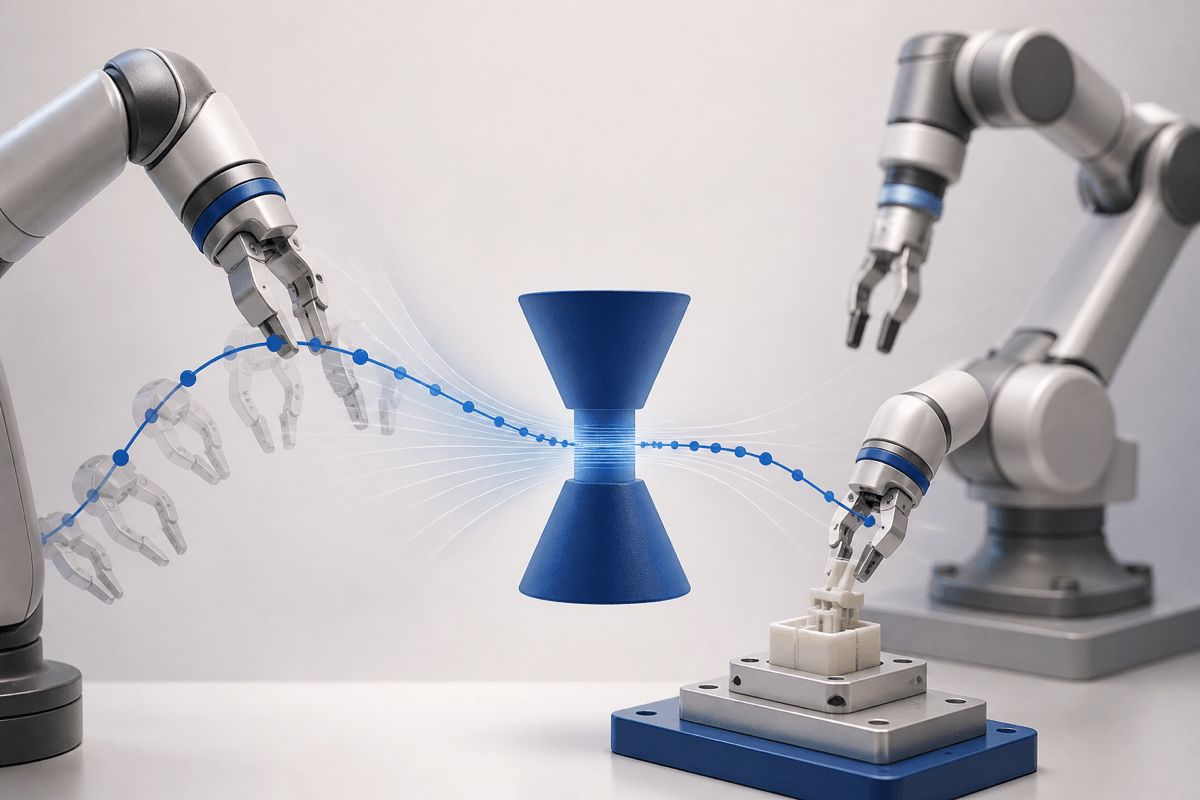
AI-generated editorial illustration. It is explanatory and does not represent measured data or a documented experiment.
8. Why it deserves attention
Action tokens determine how robot experience enters a foundation model and how predicted symbols return to hardware. Improvements here can reduce sequence length, make training cheaper and expose more robot data to autoregressive models. They can also decide whether language pretraining contributes anything useful to control.
The next decisive evidence will come from controlled comparisons across the same real robots, tasks and policy backbone. A convincing tokenizer should retain contact-critical motion, preserve instruction distinctions, decode fast enough for closed-loop use and transfer to new embodiments with limited adaptation. It should also reveal when an action lies outside its vocabulary rather than silently producing a plausible but wrong command.
The field is moving from treating action tokens as compressed coordinates toward treating them as an interface between meaning and motion. That is a necessary shift, but the interface remains lossy.
9. Sources & evidence
- FAST: Efficient Action Tokenization for Vision-Language-Action Models — Pertsch et al., primary paper, January 16, 2025, accessed September 1, 2026.
- FASTer: Toward Efficient Autoregressive Vision Language Action Modeling via Neural Action Tokenization — Liu et al., primary paper, revised December 8, 2025, accessed September 1, 2026.
- Lost in Reconstruction: Aligning Action Representations with Language in Vision-Language-Action Models — Li et al., primary paper introducing SALT, August 11, 2026, accessed September 1, 2026.
- X-Tokenizer: A Multimodal Action Tokenizer for Vision-Language-Action Pretraining — Kang et al., primary paper, revised June 28, 2026, accessed September 1, 2026.
Robot action tokenization — source register
- Research date: 2026-09-01
- Article slug:
robot-action-tokenization
| ID | Source | Type | Supported evidence and boundary |
|---|---|---|---|
| S1 | FAST — Karl Pertsch et al., 2025-01-16 | Primary research paper | Supports DCT-based frequency tokenization, FAST+ scale, π0 integration and author-reported training-time result. Comparisons apply to the paper’s tasks and pipeline. |
| S2 | FASTer — Yicheng Liu et al., v2 2025-12-08 | Primary research paper | Supports image-like action chunks, learned quantization, block-wise decoding and reported simulation/real-world advantages. Abstract does not supply every task-level condition. |
| S3 | SALT / Lost in Reconstruction — Li Wenjie et al., 2026-08-11 | Primary research paper | Supports instruction-recovery objective, BridgeV2 analysis and SimplerEnv tokenizer comparison. Does not establish the same ranking on arbitrary physical robots. |
| S4 | X-Tokenizer — Miracle Kang et al., v2 2026-06-28 | Primary research paper | Supports semantic residual quantization, 2.4M-trajectory pretraining, multimodal objectives and author-reported gains. Cross-paper metrics are not treated as directly comparable. |
Evidence boundaries
- Reconstruction error measures numerical similarity, not task meaning, contact quality or safety.
- Token counts and compression ratios do not establish policy success.
- Simulation benchmarks do not establish real-world robustness.
- Author-reported improvements remain tied to each paper’s backbone, data, baselines and evaluation protocol.
- A shared tokenizer does not remove embodiment-specific kinematics, controllers or safety constraints.