
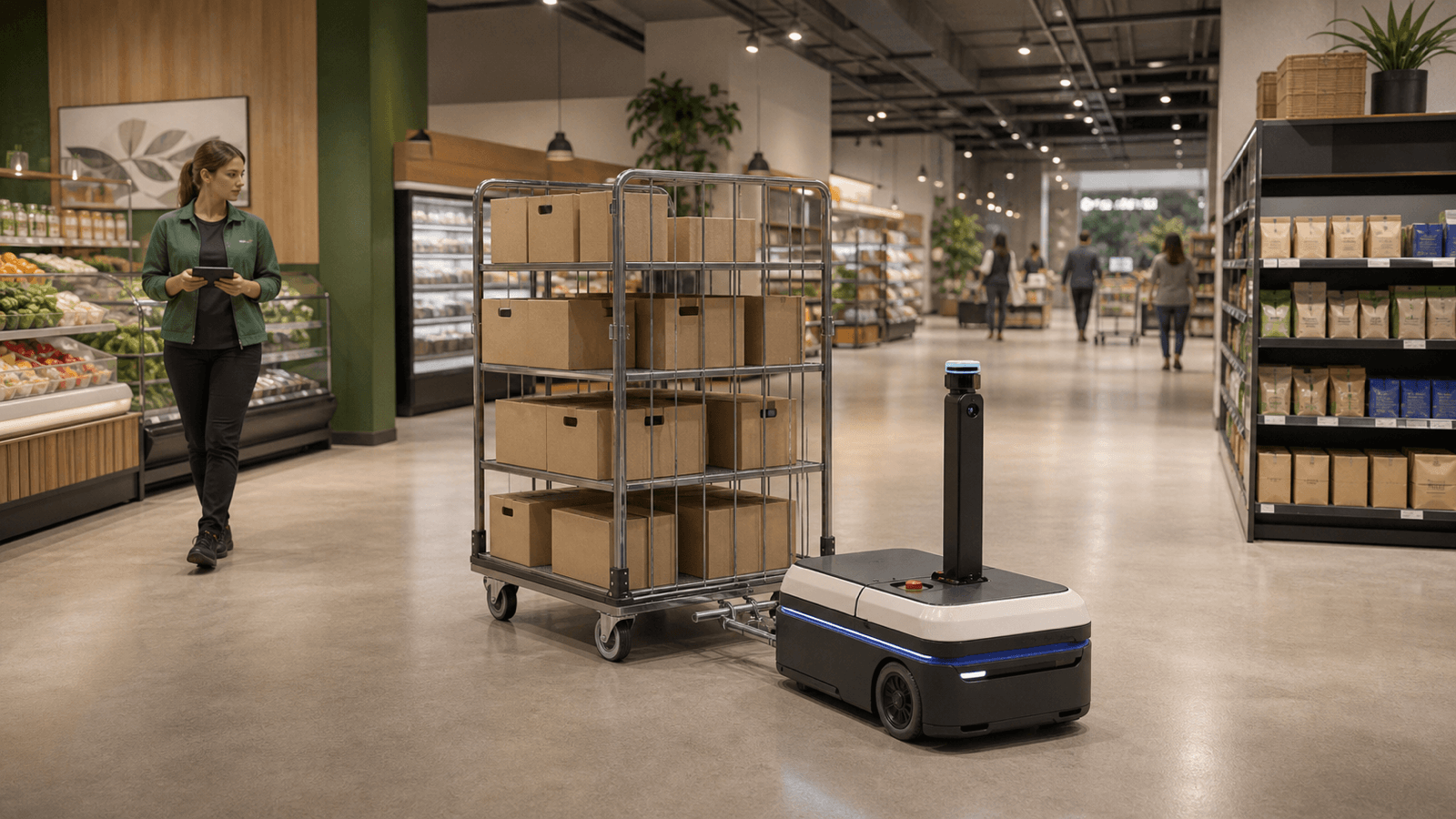
AI-generated editorial illustration. It does not depict a documented real-world event or measured result.
1. What happened
On August 25, 2026, Japanese robotics company MUSE announced that Armo One had begun operating at a Foodcellar Market grocery store in Long Island City, Queens. MUSE describes it as Armo’s first deployment in a US retail store. Operations started during August, and the initial task is moving carts loaded with merchandise inside the store. MUSE announcement
This is a live-store pilot, not a product demonstration at a conference. Foodcellar co-founder Metin Mangut said the retailer intends to evaluate Armo’s performance before considering what comes next. MUSE likewise said expansion would depend on the initial deployment. The event therefore establishes that the robot has entered an operating grocery store; it does not establish that the system has reduced labor, improved stocking speed or earned a purchase order.
2. Confirmed facts
| Fact | Evidence boundary |
|---|---|
| MUSE announced the US deployment on August 25, 2026, and says store operation began during August. | The exact commissioning date and number of completed shifts were not disclosed. |
| The deployment is at one Foodcellar Market location in Long Island City, Queens. | Foodcellar lists two Long Island City addresses, but MUSE did not identify which store hosts the pilot. |
| Armo is being used for in-store merchandise transport, including moving carts loaded with heavy products. | The route length, cart payload, trip frequency and operating hours were not published. |
| MUSE calls this its first US retail-store deployment. | This is a Company claim about MUSE’s own deployment history, not a claim that Armo is the first store robot in the United States. |
| Future expansion will be considered after the initial operation is evaluated. | No pilot end date, success threshold or follow-on commitment was announced. |
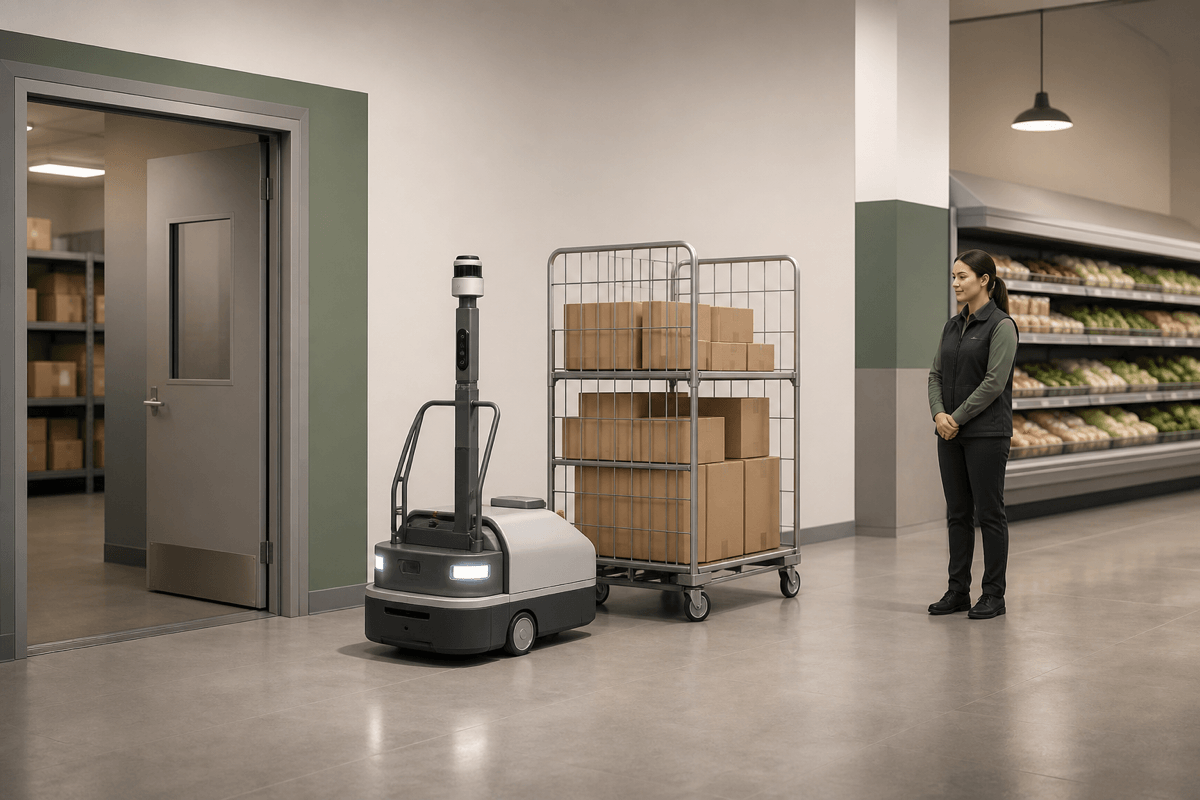
AI-generated editorial illustration. It does not depict a documented real-world event or measured result.
MUSE says the expected benefits are less staff time spent moving goods and lower physical strain, leaving workers more time for stocking, merchandising and customer service. These are intended outcomes. Neither MUSE nor Foodcellar published before-and-after labor measurements, completed-trip counts or staff feedback showing that the benefits have occurred.
3. Why it matters
Grocery transport is narrow enough to evaluate and difficult enough to expose deployment problems. A robot moving stock must share aisles with employees and shoppers, navigate temporary displays and carts, and fit into a replenishment process that changes throughout the day. Even if the robot only moves goods between designated points, it can create value when travel is frequent and physically demanding.
The pilot also tests whether a system developed through Japanese retail projects transfers to a US store layout and workflow. That involves more than navigation. Employees need a simple way to summon, load and release the robot; the machine must avoid blocking customers; and support must be available when it cannot complete a trip. Evidence on those operational details would be more useful than a broad claim that automation improves efficiency.
4. Background
MUSE presents Armo as a modular store robot. Its public materials describe transport, shelf-scanning and shopper-guidance units, plus an Eureka software platform for store images and analysis. The Foodcellar announcement discusses merchandise transport only. It provides no evidence that shelf scanning, inventory analysis or customer guidance is active in New York. MUSE product workflow
The company already has retail trials in Japan. MUSE says Welcia began testing Armo in stores in October 2024, initially using it for transport. A separate six-month proof of concept running from August 2026 to January 2027 expands promotional use to five Greater Tokyo stores and shelf scanning at one of them. That history shows MUSE has worked with different store modules, but the results disclosed for Japan cannot be transferred to the Foodcellar pilot.
MUSE formed a US subsidiary in 2024 and promoted Armo at US retail events before this deployment. Moving from exhibitions into a customer store is a real change in evidence level. It is still an early step because the public record identifies only one US store and no operating outcome.
5. What remains unknown
- How many Armo robots are operating, and at which Foodcellar Market address?
- How many trips does the robot complete per shift, over what route and with what cart payload?
- What are its task-success, human-intervention, blocked-route and manual-recovery rates?
- Does it operate while the store is open to shoppers, and what rules govern aisle access and right of way?
- How much employee walking, lifting or transport time has changed from the pre-pilot baseline?
- What uptime, charging time, maintenance visits and remote-support hours does the pilot require?
- How long will the pilot run, what metrics determine expansion, and is the equipment purchased, leased or supplied for evaluation?
AI-generated editorial illustration. It does not depict a documented real-world event or measured result.
6. Editorial analysis
The Foodcellar deployment changes Armo’s US status from showcased technology to a robot assigned a real store task. The task is concrete, the customer is named and operations have begun. Those points make the event more substantial than a future partnership announcement.
The evidence remains too thin to call the pilot commercially successful. A single-store deployment can reveal integration problems, but MUSE has not disclosed the number of robots, the workload or any baseline comparison. The language about reducing physical burden and freeing time should remain a hypothesis until Foodcellar reports measured outcomes.
The most informative follow-up would be a short customer-authored pilot report: weeks in service, trips requested and completed, payload range, interventions, downtime, employee minutes saved, aisle-blocking events and staff feedback. If those figures meet a stated success threshold and lead to a paid multi-store expansion, the pilot would demonstrate more than market entry. Until then, it is a credible operational test with unreported results.
7. Related robot, technology, and company
- Robot profile: Armo One profile not yet available.
- Company profile: MUSE company profile not yet available.
- Technology: 3D perception at scale: mapping the real world in real time explains why persistent awareness matters in changing public aisles.
- Explainer: From data to deployment: the robotics pipeline describes the evidence needed to move from a pilot into repeatable operation.
8. Sources & evidence
- MUSE launches first US deployment of autonomous store robot Armo — MUSE, primary company announcement with a named customer quotation, August 25, 2026, accessed September 1, 2026.
- MUSE begins deploying Armo at Foodcellar Market — MUSE via PR Times, primary Japanese-language company announcement, August 26, 2026, accessed September 1, 2026.
- MUSE begins first US Armo deployment — Japan Physical AI News, secondary reporting, August 26, 2026, accessed September 1, 2026.
- How store robot Armo works — MUSE, primary product and workflow page, accessed September 1, 2026.
- Welcia introduces Armo at five Greater Tokyo locations — MUSE, primary company announcement, July 28, 2026, accessed September 1, 2026.
- Foodcellar Market — Foodcellar Market, primary customer website identifying two Long Island City locations, accessed September 1, 2026.
Armo One New York grocery pilot — source register
- Access date for every source: 2026-09-01
- Primary event date: 2026-08-25
| ID | Source | Publisher / origin | Date | Type | Use and evidence boundary |
|---|---|---|---|---|---|
| S1 | MUSE launches first US deployment of autonomous store robot Armo | MUSE | 2026-08-25 | Primary company announcement | Event, month, city, customer, transport task and customer quotation. Efficiency and workload benefits are goals, not results. |
| S2 | MUSE begins deploying Armo at Foodcellar Market | MUSE via PR Times | 2026-08-26 | Primary company announcement | Japanese version confirms one store and August operation, and describes this as a validation deployment. It is not independent confirmation. |
| S3 | MUSE begins first US Armo deployment | Japan Physical AI News | 2026-08-26 | Secondary reporting | Confirms the announcement and explicitly notes missing scale, contract and outcome data. It relies mainly on the press release. |
| S4 | How store robot Armo works | MUSE | current at access | Primary product page | Product-family background: transport, scanning and guidance modules. Not evidence that all modules operate at Foodcellar. |
| S5 | Welcia introduces Armo at five Greater Tokyo locations | MUSE | 2026-07-28 | Primary company announcement | Japanese deployment history, October 2024 testing and a separate August 2026–January 2027 proof of concept. Results are not transferred to New York. |
| S6 | Foodcellar Market | Foodcellar Market | current at access | Primary customer website | Verifies that Foodcellar lists two Long Island City addresses. It does not identify the Armo host site. |
Excluded or limited evidence
- MUSE videos and photographs were not used to infer autonomous navigation, reliability, workload or safety.
- “First US deployment” is treated as MUSE’s own product history, not a category-wide first.
- The public MUSE homepage displays anticipated KPI values; they are not used because no Foodcellar-specific measurement or method is supplied.
- No customer-authored results report, contract, purchase order, deployment count, incident log or operating dataset was found.