
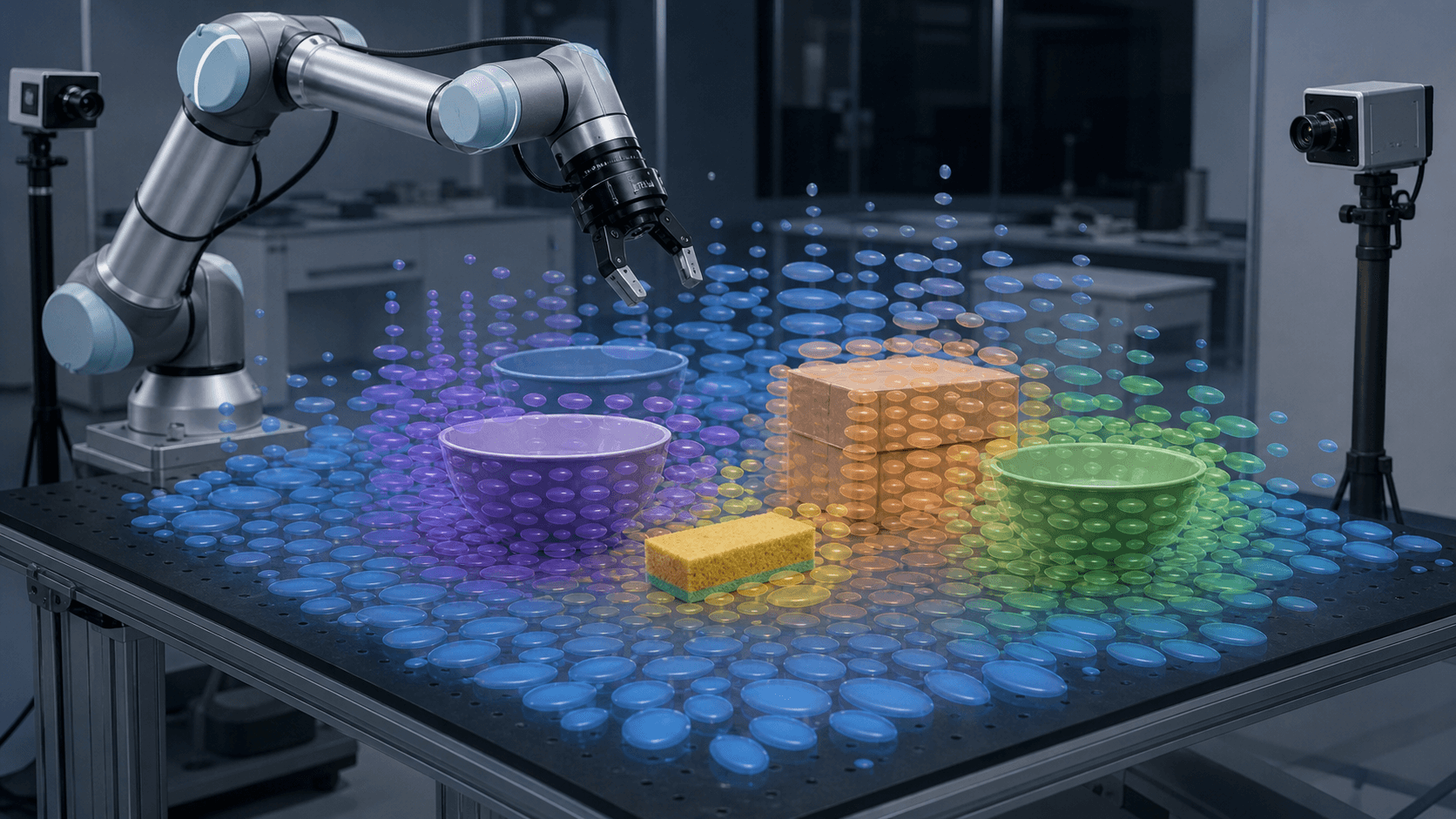
AI-generated editorial illustration. It is not a figure from the paper and does not represent experimental data.
Research at a glance
Researchers from Nanyang Technological University’s EmPACT Lab and A*STAR’s Institute for Infocomm Research submitted VistaVLA on July 14, 2026, and posted a revised preprint on July 16. The study asks whether a vision-language-action policy can manipulate objects more reliably when it receives an explicit scene-level representation combining 3D geometry with visual meaning.
VistaVLA builds a field of 3D Gaussian primitives from calibrated camera views, attaches compact semantic features to those primitives, and reduces the dense field to 64 context tokens for action prediction. The authors report improved performance on seven physical tabletop tasks and on simulated spatial-distribution shifts. The result supports a specific claim: compact, semantic 3D context helped this policy under the evaluated camera, robot and task conditions.
What the researchers did
The method has two stages. First, it trains a semantic Gaussian field using RGB, depth and feature-rendering supervision. SigLIP2 and DINOv2-Large provide complementary teacher features, which an autoencoder compresses from 2,176 dimensions to 128. Each Gaussian represents a 3D center, covariance, opacity, color and a learned 128-dimensional semantic feature. During this training stage, two calibrated RGB-D views provide context and a third view enforces cross-view consistency.
At inference, VistaVLA constructs the field online from current RGB observations and calibrated camera poses, without depth input or a third view. The raw field contains roughly 100,000 primitives, far too many for the downstream policy. A Merge-then-Query module first pools and merges them to 1,000 tokens using spatial ordering and semantic similarity, then 64 learned queries summarize them through a two-layer Transformer decoder. These tokens join ordinary image, language and action-query tokens inside a VLA-Adapter-0.5B policy.
The team evaluated seven real-world tasks—placing a sponge, stacking boxes, stacking bowls, placing a plate, organizing sponges, throwing away trash, and a multi-stage wand-and-cup task—on an Agile-Piper manipulation platform. Every method used the same task-specific demonstrations and 10 trials per task. Comparisons included VLA-Adapter with two fixed views, a depth-enhanced version, SmolVLA-0.5B and π0.5-3B. Simulation experiments covered the four standard LIBERO suites and LIBERO-Pro-Swap.
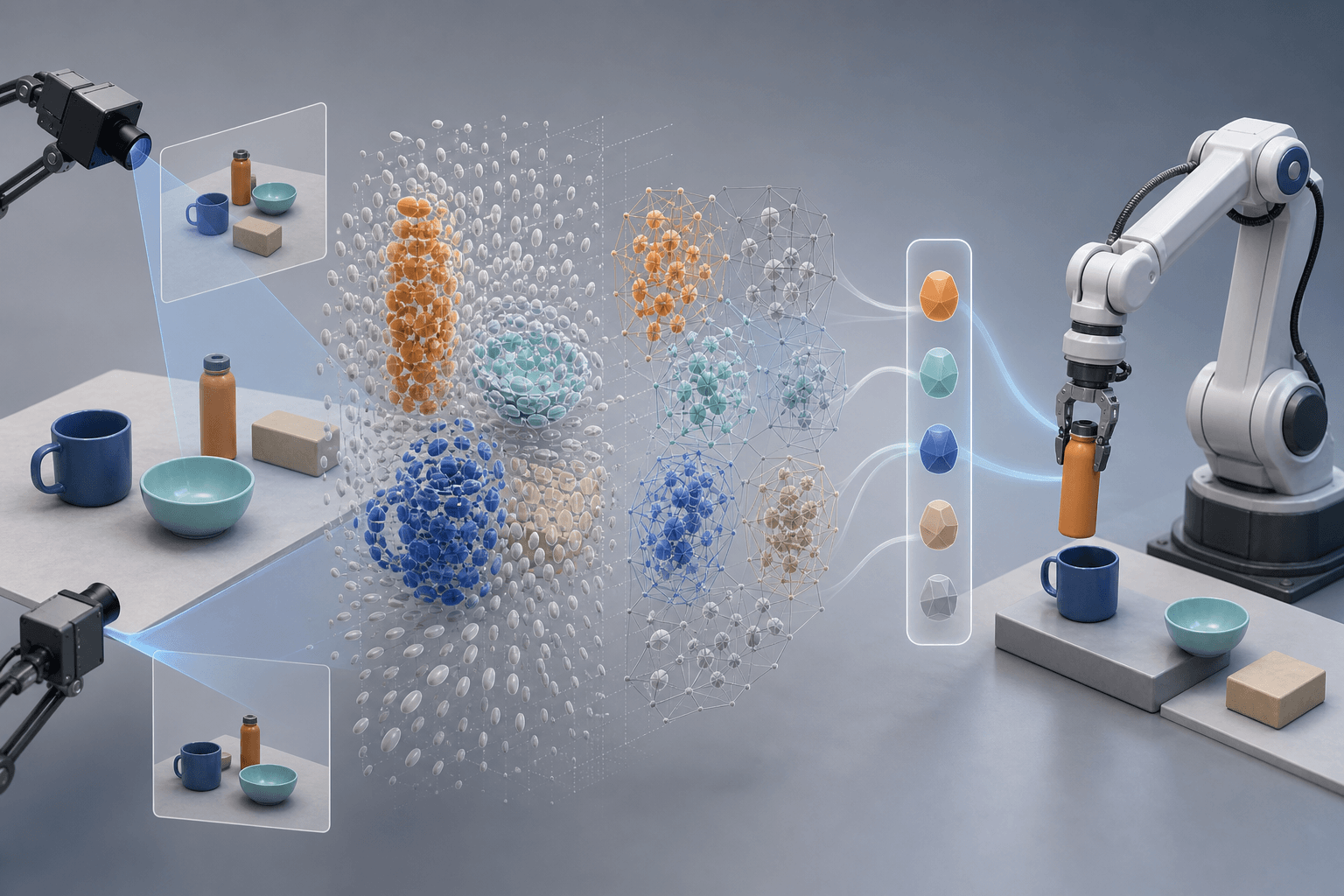
AI-generated editorial illustration. It is not a figure from the paper and does not represent experimental data.
What they found
The paper reports an average 22.8-point real-world success gain across the seven tasks and a 30-point gain over VLA-Adapter on the selected out-of-distribution tests. The individual spatial-shift trials make the scope clearer. On PlaceSponge with changed height or depth, VistaVLA succeeded in 9 of 10 trials, compared with 6 of 10 for both VLA-Adapter variants, 7 of 10 for π0.5 and 2 of 10 for SmolVLA. On OrganizeSponge with position changes, VistaVLA succeeded in 3 of 10 trials; every listed baseline recorded 0 of 10.
In simulation, VistaVLA averaged 96.05% across standard LIBERO Spatial, Object, Goal and Long suites, versus 94.1% for its VLA-Adapter baseline. On the zero-shot LIBERO-Pro-Swap evaluation, which changes scene layouts, VistaVLA averaged 12.2% while the baseline reached 1.7%. This is a large relative improvement but a low absolute success rate. Ablations also favored the full compression design: on StackBowls, 64 query tokens produced 8 successes in 10 trials, while 16, 32, 128 and 256 tokens produced 6, 5, 7 and 2 respectively.
What the result does not prove
VistaVLA does not demonstrate general-purpose 3D understanding or reliable manipulation in uncontrolled spaces. Its physical evaluation used one tabletop robot, calibrated fixed cameras, posed observations and 10 trials per task. A 3-of-10 result under position perturbation is evidence that the representation sometimes helped where the tested baselines failed, not evidence that the shift problem is solved.
The study also does not isolate every possible cause of improvement. Its ablations support the value of multiple views, merging and query summarization, but the complete system combines semantic teachers, Gaussian construction, compression and a particular policy backbone. Dynamic occlusions, inaccurate camera poses, larger workspaces and transfer to other embodiments remain open. The work is a preprint, and no official VistaVLA code or dataset release was linked from the arXiv record during research.
Practical relevance
Most VLA policies consume camera images as flat patches. VistaVLA offers a policy-facing interface that describes both where scene elements sit in 3D and what their visual features imply, while keeping the token budget small. This is relevant when a robot must distinguish objects that look similar in 2D but occupy different heights, depths or spatial relationships.
The conditional practical value is modularity: a compact 3D context could be added to an existing image-based policy without forcing the action model to process an entire dense point cloud. That benefit depends on reliable multi-view calibration and fast online scene construction. The paper does not report fleet-scale latency, maintenance or deployment results.
What to watch next
The clearest next tests are more physical trials, unfamiliar objects, moving clutter and camera-pose error. Evaluations on mobile manipulators and other arm geometries would show whether the interface transfers beyond the Agile-Piper setup. Reporting end-to-end inference latency and compute would clarify whether online Gaussian construction fits practical control loops.
Independent reproduction is equally important. A public implementation would allow researchers to separate gains from semantic grounding, geometry, additional views and token compression, and to compare the method under common demonstrations rather than paper-specific training pipelines.
Sources & evidence
- VistaVLA: Geometry- and Semantic-Aware 3D Gaussian-Grounded VLA for Robotic Manipulation — primary preprint, authors, dates and headline findings.
- VistaVLA full HTML paper — primary source for methods, trial conditions, tables, ablations and limitations.
- VistaVLA paper index on Hugging Face — supplementary public paper record.
- 3D Gaussian Splatting for Real-Time Radiance Field Rendering — original technical background for the representation family used by VistaVLA.
Sources
Primary research
-
VistaVLA: Geometry- and Semantic-Aware 3D Gaussian-Grounded VLA for Robotic Manipulation
Mohan Liu, Zhihao Gu, Xuanyu Chen, Haitian Zhang, Kaimin Mao, Yan Wu, Wei-Yun Yau and Lin Wang.
arXiv:2607.12356. Submitted 2026-07-14; version 2 posted 2026-07-16. Accessed 2026-09-01.
https://arxiv.org/abs/2607.12356
Supports: authorship, affiliations, publication status, research question and headline results. -
VistaVLA full HTML paper
Same authors and version. Accessed 2026-09-01.
https://arxiv.org/html/2607.12356
Supports: architecture, semantic feature construction, Merge-then-Query, physical evaluation protocol, LIBERO results, ablations and stated limitations.
Supplemental records and technical context
-
VistaVLA paper index
Hugging Face Papers. Published 2026-07-14. Accessed 2026-09-01.
https://huggingface.co/papers/2607.12356
Supports: supplementary public indexing of the paper and author list. It does not independently validate the results. -
3D Gaussian Splatting for Real-Time Radiance Field Rendering
Bernhard Kerbl, Georgios Kopanas, Thomas Leimkühler and George Drettakis. ACM Transactions on Graphics, 2023. Accessed 2026-09-01.
https://doi.org/10.1145/3592433
Supports: technical background for 3D Gaussian primitives; not evidence for VistaVLA’s robot performance.
Editorial source note
All reported VistaVLA performance figures come from the research team’s preprint. Supplemental sources provide paper indexing or representation background only. The article does not treat those sources as independent reproduction.