
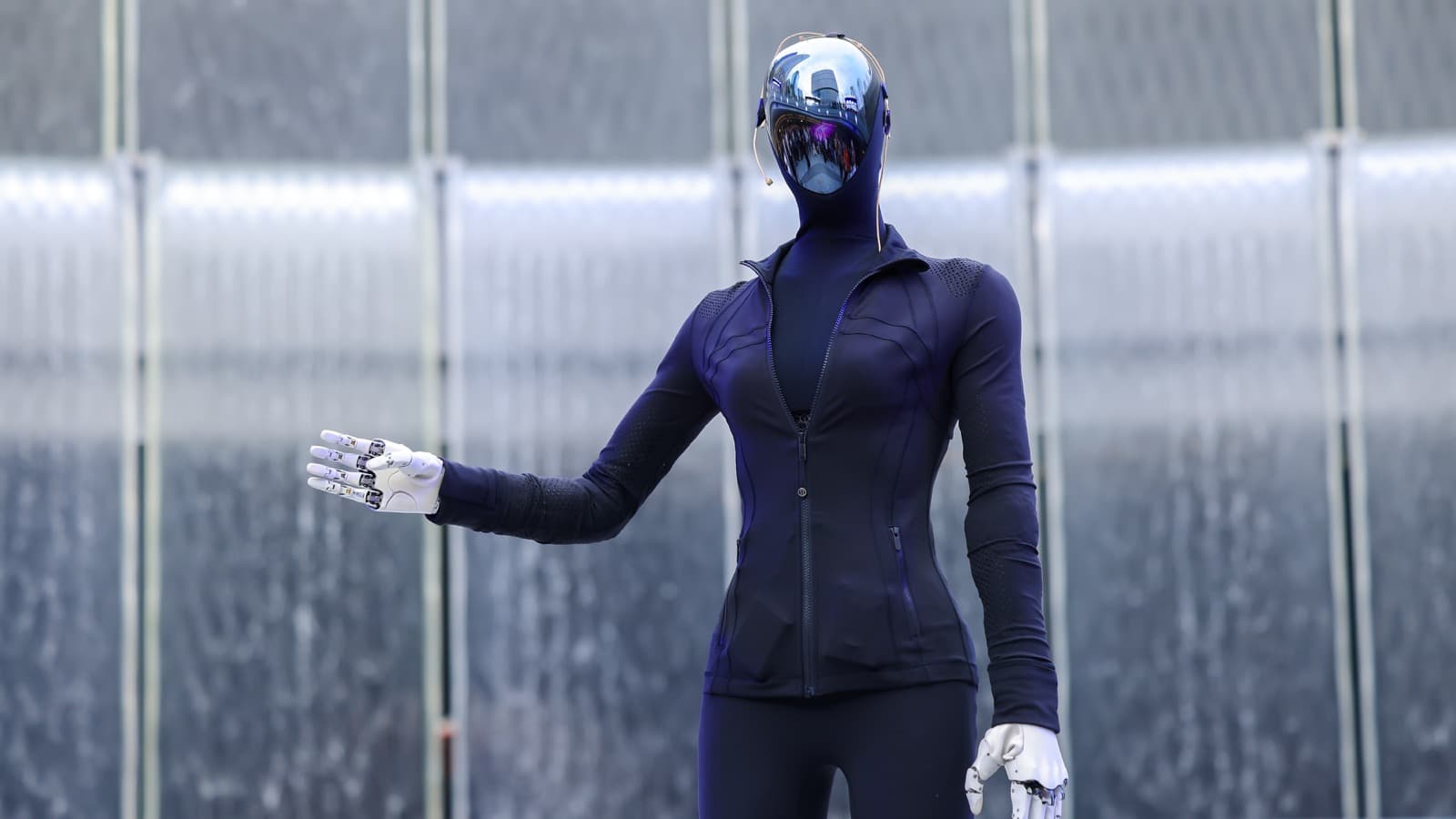
Next-Gen IRON in an official XPENG public-demonstration image. Image: XPENG; cropped and resized to 16:9 by Embodied AI Insights.
1. Identity and current status
Next-Gen IRON is XPENG’s second publicly identified humanoid generation and the hardware centerpiece of the electric-vehicle maker’s “Physical AI” program. XPENG unveiled it at AI Day on November 5, 2025, emphasizing a human-proportioned body, covered flexible structure and unusually fluid walking. The company now describes it as a general-purpose platform intended to move from demonstrations into stores, campuses and other commercial environments. 2025 AI Day announcement
As of September 1, 2026, its status is Prototype. The robot has walked in public, appeared in a Shenzhen shopping mall and attracted more than US$900 million in financing for XPENG’s robotics business. However, XPENG still frames mass production by the end of 2026 and deliveries in 2027 as future targets. No reviewed source confirms customer deliveries, a standard order process or sustained autonomous work. XPENG financing announcement Reuters report
2. Core specifications
XPENG changed several headline figures between the 2025 launch configuration and its August 2026 production-intent description. The table uses the newest official figures where available and preserves earlier dimensions only with a version warning; the two versions are not combined into a synthetic specification.
| Field | Current public information |
|---|---|
| Height | 1.73 m in XPENG’s February 2026 configuration; not reconfirmed for the August 2026 revision |
| Weight | 65 kg in XPENG’s February 2026 configuration; not reconfirmed for the August 2026 revision |
| Degrees of freedom | 76 across the body, including 21 in each hand, in the August 2026 description; earlier materials stated 82 and 22 respectively |
| Payload | Not publicly disclosed |
| Speed | Not publicly disclosed |
| Runtime | Not publicly disclosed |
| Sensors | Not publicly disclosed in component-level detail |
| Compute | Three XPENG Turing AI chips; up to 2,250 TOPS effective compute in the August 2026 description |
| Battery | All-solid-state battery claimed for the 2025–February 2026 configuration; capacity, runtime and current revision not publicly disclosed |
| Product version | Next-Gen IRON, August 2026 production-intent configuration |
The latest official release does not explain why body DoF fell from 82 to 76, hand DoF from 22 to 21, or compute from 3,000 to 2,250 TOPS. These may reflect a revised platform or a changed counting method, but neither explanation is documented. The newer figures therefore take precedence without erasing the conflict. August 2026 configuration February 2026 configuration
Several commercially important specifications remain missing. XPENG does not state lifting limits, walking speed, battery capacity, usable runtime, charge time, ingress protection or a component-level perception package. It also provides no configuration identifier that lets buyers distinguish the demonstrated body from the planned production unit. Until those fields are published, comparisons based on DoF and compute alone reveal little about useful work.
3. Product position
Company position: XPENG presents IRON as an advanced general-purpose humanoid that can learn across applications, share technology with its vehicle programs and eventually work beside people. Its highly anthropomorphic body is deliberate: human proportions should fit spaces, tools and interactions already designed around people, while the covered lattice, artificial-muscle styling and configurable forms are intended to make close contact feel safer and more legible. XPENG financing announcement
The near-term plan is narrower. XPENG identified guided tours, shopping guidance and traffic diversion as first applications, with company stores and campuses as initial deployment sites. It also named Baosteel as a partner exploring industrial inspection. Editorial view: this is a retail-and-demonstration-first program with an industrial research branch, not evidence of a general labor product. Public-facing roles reward smooth motion and social presence, but they do not prove dexterous manipulation or industrial productivity. 2025 AI Day announcement
4. Publicly claimed capabilities
Company claim: XPENG says three Turing chips run its Physical AI foundation model directly on IRON, enabling complex tasks without remote operation, low-latency inference and better data privacy. Earlier launch material described a VLT, VLA and VLM combination supporting conversation, walking and interaction, and promised that private data would remain on the robot. These are architecture and capability claims; XPENG has not published robot-specific benchmark protocols, task success rates or logs showing when remote assistance is absent. August 2026 configuration 2025 AI Day announcement
Company claim: the flexible lattice, covered exterior, human-like spine, bionic-muscle structure and articulated hands support safe, natural movement and customization. XPENG has demonstrated a catwalk-like gait, gestures and public interaction, and says the robot can adapt through real-world self-reinforcement. It has not released quantified balance recovery, grasping, force-control, collision-safety, localization or long-duration endurance results.
5. Verified capabilities
Public video and independent coverage confirm that a physical IRON robot walked onstage with a notably smooth gait at XPENG AI Day. Live Science documented the demonstration and the subsequent onstage opening of the exterior to address speculation that a person was inside. XPENG later published photographs and details from a public shopping-mall demonstration in Shenzhen. These sources verify embodied hardware, unsupported public walking and visible hand articulation under staged conditions. Live Science report XPENG Germany public demonstration
They do not verify general autonomy. No reviewed evidence reports repeated task success, obstacle recovery, manipulation accuracy, operating hours, intervention rate, safety incidents, battery endurance or work output. The stage walk and mall appearance are genuine demonstrations, but neither establishes that IRON can autonomously guide shoppers, inspect industrial assets or work a shift.
The distinction matters because locomotion is only one layer of a useful service robot. A shopping guide must localize through crowds, understand requests, maintain safe distance and recover from interruptions; an inspector must perceive defects, reach assigned locations and report results consistently. None of those end-to-end loops has a published IRON evaluation. The robot’s visible hand articulation likewise does not establish controlled grasping under load.
6. Software and developer access
XPENG says IRON uses an in-house stack spanning chips, controllers, motion modules, dexterous hands and its Physical AI foundation model. At the 2025 launch, CEO He Xiaopeng said XPENG would open an IRON SDK and build an application ecosystem with global developers. 2025 AI Day announcement
No public IRON SDK documentation, API reference, simulator, download, license, hardware interface or developer enrollment path was found in the reviewed materials. The SDK remains a roadmap statement rather than current access. It is also unknown whether customers will receive model-tuning rights, low-level control, fleet tools or only application-level interfaces.
7. Pricing and availability
IRON has no public list price, lease rate, reservation page, configuration catalog or service terms. XPENG says mass production is expected by the end of 2026, followed by an official launch and deliveries in China and overseas markets in 2027. Reuters separately reported a company target of 1,000 units of monthly output by year-end. Both are forward-looking company targets, not achieved production or guaranteed availability. XPENG financing announcement Reuters report
The current availability description is therefore: not generally available; price not publicly disclosed; commercial launch and deliveries planned for 2027. The US$900 million financing and US$6.3 billion post-money valuation apply to XPENG’s robotics business, not to the robot’s price or confirmed demand.
8. Deployment evidence
Confirmed demonstration: IRON appeared at XPENG AI Day in Guangzhou and later in a Shenzhen shopping mall. These events show that the hardware can operate in controlled public settings. Company plan: initial commercial deployments are intended for XPENG stores and campuses, while Baosteel is exploring inspection scenarios. XPENG’s June 2026 CVPR update said humanoid hardware and software were progressing toward integration and repeated the end-of-2026 mass-production target. CVPR 2026 update
No reviewed source identifies a paying IRON customer, completed delivery, deployed fleet size, continuous operating period or measured result. Baosteel’s role is described as exploration, not a published production deployment. Store, campus and overseas use remain scheduled. Those distinctions keep the status at Prototype even though production investment is substantial.
9. Editorial assessment
Next-Gen IRON’s strongest evidence is mechanical presentation: XPENG has built a coherent, human-proportioned robot that walks smoothly in public, and its automotive manufacturing base plus dedicated financing make the production plan more credible than a concept-stage promise. The latest disclosure also indicates active hardware revision rather than a frozen showpiece.
Its largest gap is task evidence. XPENG claims on-device autonomy and complex-task capability but publishes no robot-specific evaluation, developer access or operational record. The changed specifications further show why launch figures should not be repeated as settled facts. High TOPS, human-like skin and a graceful gait do not demonstrate reliable perception, manipulation, safety or economics.
The production story should therefore be evaluated in stages. A funded production line would show that XPENG can manufacture repeatable hardware; deliveries would show that counterparties will accept it; measured customer operations would show whether the system creates value. As of this review, the first stage is a stated plan and the latter two have not begun publicly.
Today, IRON is best suited to controlled demonstrations and development toward low-risk public-facing roles. Evidence that would change this assessment includes customer deliveries, a stable configuration sheet, independent safety testing, a public SDK, and multi-week site results reporting tasks, success rate, interventions, uptime and maintenance.
10. Update history
- 2026-09-01: Profile created. Status set to Prototype; the August 2026 production-intent specifications supersede, but do not conceal, conflicting earlier figures.
- 2026-08-25: XPENG announced more than US$900 million in robotics financing, published revised 76-DoF, 21-DoF-hand and 2,250-TOPS figures, and targeted 2027 deliveries.
- 2026-06-03: XPENG reiterated end-of-2026 mass-production plans at CVPR 2026.
- 2026-02-05: XPENG documented a Shenzhen mall demonstration and an earlier 1.73 m, 65 kg, 82-DoF configuration.
- 2025-11-05: Next-Gen IRON debuted at XPENG AI Day with an earlier 82-DoF, 22-DoF-hand and 3,000-TOPS description.
11. Sources & evidence
- XPENG Robotics raises over US$900 million — XPENG, primary corporate and product update, 2026-08-25, accessed 2026-09-01.
- XPENG unveils Next-Gen IRON at AI Day — XPENG, primary launch announcement, 2025-11-05, accessed 2026-09-01.
- XPENG showcases Physical AI at CVPR 2026 — XPENG, primary technology and roadmap update, 2026-06-03, accessed 2026-09-01.
- Next-Gen IRON moves from the lab into public — XPENG Germany Newsroom, primary demonstration and media-kit release, 2026-02-05, accessed 2026-09-01.
- XPENG robotics unit valued above US$6.3 billion — Reuters, independent reporting, 2026-08-24, accessed 2026-09-01.
- XPENG’s humanoid robot walked so smoothly it prompted an onstage inspection — Live Science, independent reporting, 2025-11-07, accessed 2026-09-01.
XPENG Next-Gen IRON — sources
- Article slug:
xpeng-next-gen-iron - Access date for all web sources: 2026-09-01
S1. XPENG Robotics raises over US$900 million
- Publisher: XPENG
- URL: https://www.xpeng.com/pressroom/news/01a03797fccda01e0de68a02a256006a
- Publication date: 2026-08-25
- Source type: Primary corporate financing and current product update
- Supports: funding and valuation; current 76 body DoF and 21 hand DoF; three Turing chips and 2,250 TOPS; enclosed flexible lattice; on-device foundation-model claim; intended stores/campuses deployment; end-2026 mass production; 2027 launch and deliveries.
- Boundary: product performance and autonomy language is supplied by XPENG; schedules are forward-looking; no customer task results, price or order terms are published.
S2. XPENG unveils Next-Gen IRON at AI Day
- Publisher: XPENG
- URL: https://www.xpeng.com/pressroom/news/019a56f54fe99a2a0a8d8a0282e402b7
- Publication date: 2025-11-05
- Source type: Primary launch announcement
- Supports: public debut; second-generation lineage; human-like structure; earlier 82 body DoF, 22 hand DoF, 3,000 TOPS and all-solid-state battery claims; VLT/VLA/VLM architecture; intended tours, shopping guidance and traffic diversion; Baosteel exploration; promised SDK.
- Boundary: figures are launch-version claims and conflict with the August 2026 configuration; demonstrations do not establish general autonomy or production readiness.
S3. XPENG showcases Physical AI at CVPR 2026
- Publisher: XPENG
- URL: https://www.xpeng.com/pressroom/news/019e95aed2899e8226228a028d650112
- Publication date: 2026-06-03
- Source type: Primary technology and roadmap update
- Supports: continued development of the physical-world foundation model and humanoid program; progress toward hardware-software integration; repeated end-2026 mass-production target.
- Boundary: the release’s numerical VLA deployment and training results concern XPENG vehicles and are not transferred to IRON.
S4. Next-Gen IRON moves from the lab into public
- Publisher: XPENG Germany Newsroom
- URL: https://xpeng-newsroom.pr.co/de-DE/260486-humanoider-xpeng-roboter-next-gen-iron-geht-aus-dem-labor-in-die-offentlichkeit/
- Publication date: 2026-02-05
- Source type: Primary regional press release and media kit
- Supports: Shenzhen shopping-mall demonstration; earlier 1.73 m, 65 kg, 82 body DoF, 22 hand DoF and 3,000 TOPS description; public media assets.
- Boundary: specifications precede the August 2026 revision; the public appearance does not provide task, intervention, endurance or safety metrics.
S5. XPENG robotics unit valued above US$6.3 billion
- Publisher: Reuters, syndicated by MarketScreener
- URL: https://www.marketscreener.com/news/xpeng-s-robotics-unit-valued-at-over-6-3-billion-after-record-funding-round-ce7858dbd880ff2d
- Publication date: 2026-08-24
- Source type: Independent reporting
- Supports: financing and valuation context; use of proceeds; company target of 1,000 units monthly output by year-end; intended initial sites and 2027 delivery schedule.
- Boundary: Reuters reports the company’s production target and schedule; it does not verify completed output, orders or deployments.
S6. XPENG’s humanoid robot walked so smoothly it prompted an onstage inspection
- Publisher: Live Science
- URL: https://www.livescience.com/technology/robotics/watch-chinese-companys-new-humanoid-robot-moves-so-smoothly-they-had-to-cut-it-open-to-prove-a-person-wasnt-hiding-inside
- Publication date: 2025-11-07
- Source type: Independent technology reporting based on public demonstration and company materials
- Supports: public onstage walking demonstration; visible articulated construction; contemporary public reaction; near-term exclusion of household chores in favor of controlled commercial settings.
- Boundary: the report does not independently test autonomy or endurance; its 2,250-TOPS value conflicts with XPENG’s contemporaneous 3,000-TOPS launch release and is excluded from version dating.