
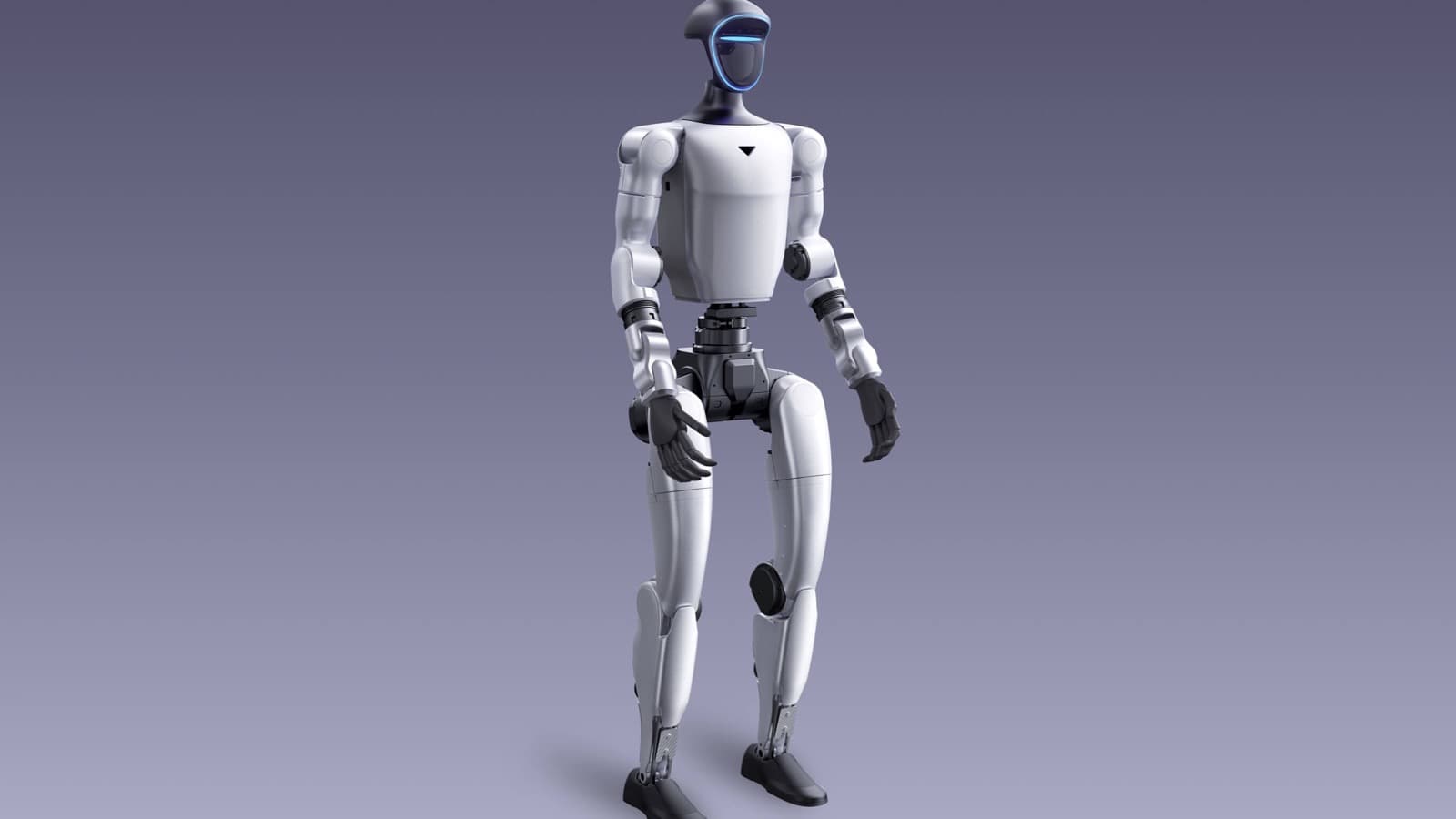
Unitree G1 in an official product render. Image: Unitree Robotics; cropped to 16:9 by Embodied AI Insights.
1. Identity and current status
Unitree G1 is a compact electric humanoid made by Hangzhou-based Unitree Robotics. Announced in May 2024, it combines a human-shaped mobile platform with unusually low entry pricing for this category. Unitree now lists the standard G1 in its online store for US$13,500 and separately offers configurable G1 EDU editions through sales. As of September 1, 2026, the appropriate status is Commercial: a buyer can place an order for the standard machine, although the store currently marks it backordered, while developer configurations require a quotation. That is stronger than a prototype or demonstration status but does not establish mass-market adoption or useful general autonomy. Unitree product page Official store
Unitree described an August 2024 revision as the G1 “mass production version.” That is a Company claim about production readiness, not a disclosed production volume. The same 2024 event page listed a height of about 127 cm, whereas the current specification table lists 1320 mm. This profile uses the current product-page figure and treats the earlier number as superseded, rather than averaging them or applying it to every configuration. Unitree World Robot Conference report
2. Core specifications
| Field | Standard G1 | G1 EDU | Evidence boundary |
|---|---|---|---|
| Height | 1320 × 450 × 200 mm standing | 1320 × 450 × 200 mm standing | Current official dimensions; folded size is 690 × 450 × 300 mm |
| Weight | About 35 kg with battery | About 35 kg or more with battery | Final EDU weight changes with options |
| Total degrees of freedom | 23 | 23–43 | EDU total depends on waist, wrist, and hand options |
| Payload | About 2 kg maximum arm load | About 3 kg maximum arm load | Company rating; Unitree says load varies greatly with arm extension posture |
| Speed | Not publicly disclosed for the current product specification | Not publicly disclosed for the current product specification | Unitree reported a trotting demonstration above 2 m/s in 2024, not a current rated operating speed |
| Runtime | About 2 hours | About 2 hours | Company rating; workload and test procedure are not published |
| Sensors | Depth camera and 3D LiDAR | Depth camera and 3D LiDAR; optional tactile arrays with Dex3-1 hands | Exact models, ranges, resolution, and redundancy are not disclosed |
| Compute | 8-core high-performance CPU | 8-core CPU plus optional high-compute modules such as Nvidia Orin | Exact processor and EDU module configurations require confirmation |
| Battery | Quick-release 9000 mAh, 13-series lithium battery; 54 V 5 A charger | Same published battery and charger | Chemistry, energy in Wh, cycle life, and tested runtime duty cycle are not disclosed |
| Product version | G1, 23 DoF, no secondary development | G1 EDU, 23–43 DoF with configurable hands, wrists, waist, and compute | Features must not be mixed across tiers |
Other published hardware includes six degrees of freedom per leg, five per arm, one waist degree of freedom on the standard model, 90 Nm maximum knee-joint torque on G1 and 120 Nm on G1 EDU, dual joint encoders, four microphones, a 5 W speaker, Wi-Fi 6, and Bluetooth 5.2. The optional Dex3-1 hand has seven active degrees of freedom—three in the thumb and two in each of two fingers—plus optional two-degree-of-freedom wrists. These are manufacturer specifications, not independent endurance or safety results. Unitree product page
3. Product position
G1 occupies a different position from enterprise humanoids sold only through closed pilot programs. The standard version is a relatively affordable finished machine for demonstrations and controlled operation; the EDU line is the meaningful research and development platform. Unitree places G1 under consumer and education products, but its own product page warns individual buyers that the humanoid industry remains at an early stage and urges them to understand the machine’s limitations before purchase.
For laboratories, G1 offers a complete bipedal body without requiring a team to build motors, mechanics, power electronics, perception hardware, and communications from scratch. Independent evidence supports that role. UCL added a G1 to its Intelligent Robotics Group for student work on vision and control, and Associated Press reporting in 2026 found Unitree machines prevalent at a US humanoid conference partly because researchers buy the lower-cost hardware to test their own software. UCL Engineering Associated Press
The market distinction is therefore not “cheap autonomous worker.” It is purchasable humanoid hardware with a separate developer tier. For ordinary buyers, the standard model’s lack of secondary development is a decisive constraint. For research groups, EDU pricing, selected hands, compute, support, safety procedures, and replacement parts all affect the real acquisition cost.
4. Publicly claimed capabilities
Company claim: Unitree presents G1 as an imitation- and reinforcement-learning-driven humanoid with continuous over-the-air software updates, wide joint motion, dynamic standing and folding, force-controlled dexterous manipulation, and support for its UnifoLM robot model work. Official videos and event demonstrations have shown walking, trotting, recovery, dancing, martial-arts-style motion, tool use, object handling, and other prepared behaviors. Unitree has also promoted optional Dex3-1 hands with force-position hybrid control and tactile sensor arrays. Unitree product page
Those demonstrations should be read literally. They show that particular G1 configurations can execute trained motion policies or controlled routines under selected conditions. They do not prove that a standard retail G1 arrives able to understand a home, choose safe actions, manipulate arbitrary objects, or reproduce every video. Unitree itself says some sample functions on the product page remain in development and testing and will open to users later. The company also warns users to keep a safe distance because of the robot’s complex structure and power.
5. Verified capabilities
Independent and academic work verifies that G1 can serve as a programmable physical research platform, but the strongest results remain narrow. A June 2026 preprint validated an energy-aware reinforcement-learning policy on the physical robot’s seven-degree-of-freedom left arm across three independent batches of ten targets. The reported mean position error was 2.64 ± 1.04 cm and mean orientation error was 6.92 ± 1.33 degrees, within the authors’ stated training tolerance. This supports controlled arm-reaching research; it does not establish general manipulation. Energy-Efficient Arm Reaching
A separate April 2026 paper streamed inverse-kinematics commands through the Unitree SDK to a real G1 and reported successful grasping at five workspace positions. Its system combined object detection, 3D reconstruction, pose tracking, and a Unity planner. That verifies a complete custom grasping pipeline on hardware, while the small, authored experiment leaves reliability across objects, lighting, disturbances, and long runs unknown. Rapid Deployment Pipeline for Autonomous Humanoid Grasping
Public live observation provides a useful boundary. At a 2025 robotics summit, AP saw a G1 walk, wave, shake hands, and distribute brochures, but reported that a nearby Unitree employee was remotely controlling it. The evidence confirms stable public teleoperation and mobility in a crowded exhibition; it does not confirm autonomous navigation or factory work. Associated Press
6. Software and developer access
The standard US$13,500 G1 does not support secondary development, according to Unitree’s official store. Buyers who need customization are directed to G1 EDU. This product-tier restriction overrides any assumption that public SDK code automatically grants low-level access on every machine.
For compatible developer hardware, Unitree publishes BSD-3-Clause-licensed C++ SDK2 code and G1 examples for high-level locomotion, five- and seven-axis arms, hands, audio, and low-level control. Its Python repository also includes G1 examples. Hugging Face’s LeRobot documentation adds third-party support for 23- and 29-DoF variants, simulation, teleoperation, dataset recording, locomotion controllers, and policy training. These repositories demonstrate an active software path, not a guarantee that every firmware, EDU option, controller, or learned behavior is mutually compatible. Unitree SDK2 G1 SDK examples LeRobot G1 documentation
Public documentation does not provide one complete entitlement matrix for EDU variants, low-level interfaces, included software, support response, model licenses, or safety certification. A serious buyer should obtain the exact bill of materials, SDK access, firmware version, hand interface, compute module, warranty, and support terms in the quotation.
7. Pricing and availability
Unitree’s official store lists the standard G1 at US$13,500, excluding taxes. Shipping is listed at US$300–$1,200, and the buyer is responsible for customs duties, taxes, and import clearance. On September 1, 2026, the listing accepted cart orders but marked G1 backordered and said it would ship when back in stock. Delivery timing is available on request. Official store
G1 EDU has no public list price; buyers must contact Unitree sales. The product page lists an eight-month warranty for standard G1 and an 18-month warranty for EDU, while detailed warranty conditions are contained in a separate brochure. Prices for hands, wrist and waist options, high-compute modules, spare batteries, training, support, and repairs are Not publicly disclosed in the reviewed product pages. Availability, import rules, and final landed cost vary by region.
8. Deployment evidence
The clearest named adoption is research and education rather than autonomous labor. UCL publicly identified its G1 and described student programming work. The two 2026 papers document physical experiments in arm reaching and grasping. AP independently reported that academic researchers are a main customer group outside China and later observed the prevalence of Unitree robots at a US humanoid summit. Together, these sources support commercial research-platform adoption.
No reviewed source provides a named external customer running G1 in sustained productive factory, warehouse, retail, or home work with disclosed hours, fleet size, success rate, interventions, safety events, or economics. Unitree’s 2024 statement that its humanoids had been deployed for factory handling is a Company claim that does not identify the model, customer, scale, or results. Public performances, competitions, and viral movement videos are deployments in the everyday sense, but they are demonstrations rather than evidence of an autonomous workforce.
9. Editorial assessment
G1 is currently most credible as an accessible humanoid body for well-equipped robotics laboratories, educators, integrators, and experienced developers. Its strongest evidence is not a viral kick or dance. It is the combination of a real purchase channel, current specifications, public SDK examples, third-party framework support, named university ownership, and physical academic experiments. Few humanoid platforms expose that combination at this entry price.
The largest gap is the distance between hardware access and dependable autonomy. The cheapest model is not developer-enabled; EDU pricing is opaque; configurations vary; rated runtime and payload lack public test protocols; and no named customer has released sustained operational metrics. A convincing multi-month report showing the exact G1 configuration, task volume, autonomy rate, interventions, failures, maintenance, safety events, and total cost would materially change this assessment. Until then, G1 should be understood as a commercial research and demonstration platform—not a general-purpose household or industrial worker.
10. Update history
- 2026-09-01: Profile created. Current status set to Commercial because standard G1 is sold through Unitree’s official store; mass-production volume and productive deployments remain unverified.
- 2026-06-14: Researchers published physical G1 arm-reaching results across three ten-target batches.
- 2026-04-19: Researchers published a G1 grasping pipeline with five real-robot workspace positions.
- 2026-03: Hugging Face’s LeRobot G1 guide documented 23- and 29-DoF support, simulation, teleoperation, and policy workflows.
- 2025-07: UCL publicly documented its G1 research and teaching platform.
- 2024-08-19: Unitree announced what it called the G1 mass-production version.
- 2024-05-13: Unitree introduced G1.
11. Sources & evidence
- Unitree G1 product page — Unitree Robotics, primary live product page, undated, accessed 2026-09-01.
- Unitree G1 official store listing — Unitree Robotics, primary commerce page, undated, accessed 2026-09-01.
- Unitree Robotics at World Robot Conference 2024 — Unitree Robotics, primary company report, 2024, accessed 2026-09-01.
- Unitree SDK2 and G1 examples — Unitree Robotics, primary open-source repositories, continuously updated, accessed 2026-09-01.
- LeRobot Unitree G1 documentation — Hugging Face, third-party developer documentation, updated 2026-03, accessed 2026-09-01.
- Where robotics gets real — UCL Engineering, institutional adoption evidence, 2025-07, accessed 2026-09-01.
- Energy-Efficient Arm Reaching for a Humanoid Robot — Deniz, Parsons, and Auat Cheein, research preprint, 2026-06-14, accessed 2026-09-01.
- A Rapid Deployment Pipeline for Autonomous Humanoid Grasping — Yan, Dai, and Ye, research preprint, 2026-04-19, accessed 2026-09-01.
- US robot makers hope to beat China in humanoid race — Associated Press, independent live reporting, 2025-05-02, accessed 2026-09-01.
- Humanoid robots take center stage at Silicon Valley summit — Associated Press, independent industry reporting, 2026, accessed 2026-09-01.
Unitree G1 — sources
- Article slug:
unitree-g1 - Access date for all web sources: 2026-09-01
S1. Unitree G1 product page
- Publisher: Unitree Robotics
- URL: https://www.unitree.com/g1/
- Publication date: Undated live page
- Source type: Primary product page
- Supports: current variants, dimensions, weight, degrees of freedom, arm load, joints, sensors, compute, battery, runtime, communications, hands, developer-access distinction, warranty, price, capability claims, safety warning, and early-industry disclaimer.
- Boundary: specifications and capability descriptions are company claims without public test protocols.
S2. Unitree G1 official store listing
- Publisher: Unitree Robotics
- URL: https://shop.unitree.com/collections/humanoid-robot/products/unitree-g1
- Publication date: Undated live commerce page
- Source type: Primary commerce page
- Supports: US$13,500 standard price; US$300–$1,200 shipping range; buyer responsibility for duties, taxes, and clearance; backorder status; standard model’s lack of secondary development; EDU sales-contact route.
- Boundary: delivery timing and G1 EDU pricing are not published.
S3. Unitree Robotics at World Robot Conference 2024
- Publisher: Unitree Robotics
- URL: https://www.unitree.com/news1/
- Publication date: 2024
- Source type: Primary company report
- Supports: May 2024 release; August 19, 2024 “mass production version” announcement; older 127 cm figure; company-reported above-2 m/s trotting demonstration; prepared movement and manipulation demonstrations; non-specific factory-handling claim.
- Boundary: production scale, test procedures, specific factory customer, model, duration, and results are not disclosed.
S4. Unitree SDK2 and G1 examples
- Publisher: Unitree Robotics
- URLs: https://github.com/unitreerobotics/unitree_sdk2 and https://github.com/unitreerobotics/unitree_sdk2/tree/main/example/g1
- Publication date: Continuously updated repository
- Source type: Primary open-source software and documentation
- Supports: BSD-3-Clause SDK; Ubuntu build environment; public G1 high-level, low-level, hand, arm, audio, and locomotion examples.
- Boundary: repository availability does not grant low-level access on the standard non-developer G1 or define every EDU entitlement.
S5. LeRobot Unitree G1 documentation
- Publisher: Hugging Face
- URL: https://github.com/huggingface/lerobot/blob/main/docs/source/unitree_g1.mdx
- Publication date: Last updated 2026-03
- Source type: Third-party developer documentation
- Supports: support for 23- and 29-DoF G1 variants; MuJoCo simulation; physical robot connection; teleoperation; locomotion controllers; dataset recording; policy training and inference.
- Boundary: project documentation is not a Unitree commercial entitlement or compatibility warranty.
S6. Where robotics gets real
- Publisher: UCL Engineering
- URL: https://www.ucl.ac.uk/engineering/computer-science/study/undergraduate/where-robotics-gets-real-new-humanoid-robot-joins-ucl-intelligent-robotics-group
- Publication date: 2025-07
- Source type: Primary institutional adoption report
- Supports: UCL Intelligent Robotics Group ownership of a G1; use in teaching and student work on vision and control.
- Boundary: describes research intentions and early use, not sustained autonomous task performance.
S7. Energy-Efficient Arm Reaching for a Humanoid Robot
- Publisher: arXiv; authors Nestor N. Deniz, Simon Parsons, and Fernando Auat Cheein
- URL: https://arxiv.org/abs/2606.15918
- Publication date: 2026-06-14
- Source type: Academic preprint and physical-robot experiment
- Supports: seven-DoF G1 left-arm control; three independent ten-target physical batches; reported energy and pose errors within the authors’ training tolerance.
- Boundary: a narrow reaching experiment, not general manipulation or product certification; preprint was not identified as peer reviewed.
S8. A Rapid Deployment Pipeline for Autonomous Humanoid Grasping
- Publisher: arXiv; authors Yifei Yan, Weilei Dai, and Linqi Ye
- URL: https://arxiv.org/abs/2604.17258
- Publication date: 2026-04-19
- Source type: Academic preprint and physical-robot experiment
- Supports: Unitree SDK commands streamed to G1; real-robot grasping at five workspace positions; integrated perception and planning pipeline.
- Boundary: limited test positions and authored experimental setup do not establish broad reliability; preprint was not identified as peer reviewed.
S9. US robot makers hope to beat China in humanoid race
- Publisher: Associated Press
- URL: https://apnews.com/article/trump-tariffs-robots-cbb16a14376e34c48733618616c5afe2
- Publication date: 2025-05-02
- Source type: Independent live-event reporting
- Supports: observed remote-controlled G1 walking, waving, handshaking, and brochure distribution; academic researchers as a main customer group outside China; historical US price context.
- Boundary: event behavior was teleoperated; the 2025 price and tariff calculation are not used as the current global price.
S10. Humanoid robots take center stage at Silicon Valley summit
- Publisher: Associated Press
- URL: https://apnews.com/article/humanoid-robots-summit-ai-874550fa04954d689d011ffc37751616
- Publication date: 2026
- Source type: Independent industry reporting
- Supports: prevalence of Unitree humanoids at a US summit and researcher adoption linked to relatively low hardware cost; broader limits of general-purpose humanoids.
- Boundary: conference prevalence is not a Unitree shipment total or deployment metric.