
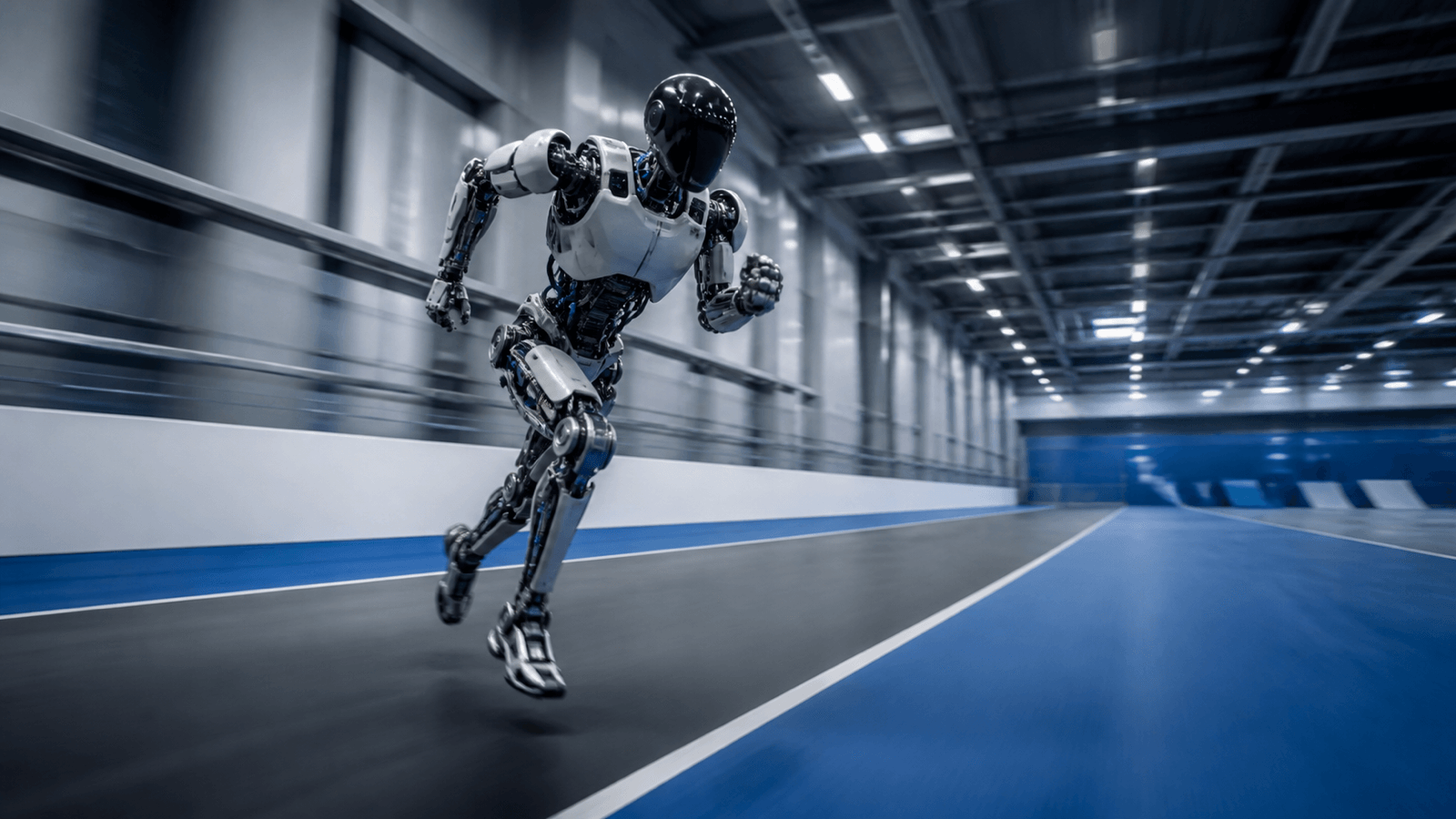
AI-generated editorial illustration. It does not depict a documented real-world event or measured result.
1. What happened
On August 26, 2026, Tiangong Ultra completed the large-size humanoid 100-metre final in 8.64 seconds at the second World Humanoid Robot Games in Beijing. The result won the event and improved on the same model’s 8.86-second semifinal time from the previous day and its earlier 9.39-second Games mark. CGTN
The finish also revealed a limitation hidden by the headline number. The Associated Press reported that several runners, including the champion, crashed into a padded barrier after crossing the line. Sparks came from some fallen robots, staff used fire extinguishers, and almost all runners were eventually removed on stretchers. The evidence therefore supports two conclusions at once: Tiangong Ultra completed an exceptionally fast timed sprint, and it did not finish with a controlled stop. Associated Press
2. Confirmed facts
| Fact | Evidence boundary |
|---|---|
| Tiangong Ultra won the large-size 100-metre final in 8.64 seconds on August 26. | The public reports do not provide the complete timing protocol or raw timing data. |
| The same model recorded 9.39, 8.86 and 8.64 seconds during the Games. | These times show repeated improvement within the event, not long-term repeatability. |
| Beijing Innovation Center of Humanoid Robotics, also known as X-Humanoid, developed the robot. | The public record does not itemize the exact hardware and software configuration used in each race. |
| The champion was among the robots that hit a padded barrier after the finish. | AP did not attribute the reported sparks or extinguisher use specifically to Tiangong Ultra. |
| The Games used a predictable indoor track and a purpose-built finish barrier. | Performance in this setting does not establish safe operation in workplaces or public space. |
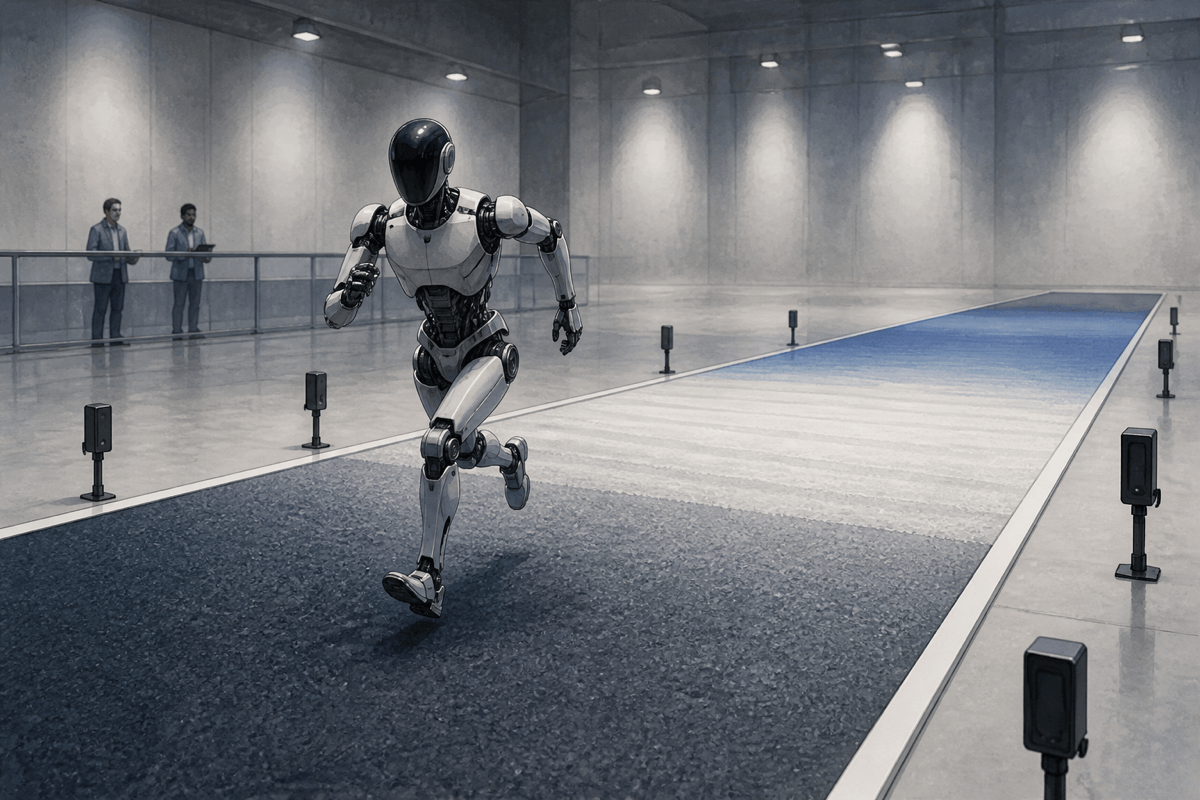
AI-generated editorial illustration. It does not depict a documented real-world event or measured result.
X-Humanoid’s own announcement says Tiangong Ultra won the large-size category and that its entries took both gold and silver. It attributes the result to the company’s Huisi Kaiwu control platform. That establishes the developer’s stated technical context, but it does not publish control architecture, training data, energy consumption, intervention rules or independent performance analysis. X-Humanoid
3. Why it matters
Running at this speed requires rapid leg cycling, balance correction, actuator output and tightly coordinated contact with the floor. Cutting a 100-metre result from 21.50 seconds at the 2025 Games to 8.64 seconds in 2026 would represent a major competition-level improvement for the platform, although the three sources used here do not provide a controlled year-to-year hardware comparison.
Yet acceleration is only one part of mobility. A useful robot must also decelerate, stop within available space, recover from disturbances and avoid creating new hazards. The padded wall allowed competitors to optimize a timed sprint without proving those capabilities at the finish. That does not invalidate the record. It defines what the record measures.
4. Background
The five-day event brought together 2,056 humanoid robots representing 666 teams across 51 events, according to CGTN. Its program combined sports with 21 scenario-based events involving factories, hotels, supermarkets and emergency response. Sprinting is visually simple and produces a clear result, which makes it attractive as a benchmark and public spectacle.
The comparison with Usain Bolt’s 9.58-second human world record is mathematically correct but technically incomplete. Human athletics requires an unaided standing start, a regulated track, human physiology and a finish that the athlete must survive and exit under control. A humanoid competition may use different start procedures, autonomy rules, timing systems, robot dimensions and stopping provisions. Without the full rulebook and configuration record, the two numbers should not be treated as equivalent achievements.
The improvement within the Games is more informative. Tiangong Ultra lowered its recorded time from 9.39 to 8.86 and then 8.64 seconds. That sequence suggests the team could tune or operate the platform effectively under the same event’s conditions. It still does not show how often the robot could reproduce 8.64 seconds, how much hardware stress accumulated, or whether the final configuration remained usable after hitting the barrier.
5. What remains unknown
- Was the entire run autonomous, remotely supervised or directly controlled, and what did the competition rules permit?
- How were the start and finish detected, and was 8.64 seconds raw elapsed time or an adjusted score?
- What robot hardware, software and controller settings were used in the final?
- How many complete attempts were made, and how often did Tiangong Ultra finish successfully?
- What peak speed, power draw, battery consumption and actuator temperatures were recorded?
- What damage, if any, resulted from the finish-line collision?
- Could the robot decelerate safely from the same speed without a padded barrier?
- How would its controller respond to uneven ground, obstacles, people or an unexpected route change?
AI-generated editorial illustration. It does not depict a documented real-world event or measured result.
6. Editorial analysis
The 8.64-second run is meaningful evidence of high-speed bipedal locomotion in a constrained environment. It demonstrates that a full-size humanoid platform can traverse a straight, level 100-metre course at a pace that would have appeared implausible in this competition one year earlier. Repeatedly lowering the event mark over several rounds also provides more information than a single isolated promotional clip.
The uncontrolled finish is equally meaningful. A mobility system designed for real deployment cannot treat the end of a route as a sacrificial zone. Stopping distance, balance during deceleration, obstacle avoidance and post-run readiness belong to the task definition. If the benchmark excludes them, teams will rationally optimize speed while relying on physical infrastructure to absorb the remaining energy.
A better next benchmark would join acceleration, cruising, deceleration and recovery in one measured run. It would publish whether control was autonomous, require the robot to stop upright inside a marked zone, report energy use and hardware damage, and repeat the attempt enough times to establish a success rate. A course with gentle turns or a controlled unexpected obstacle would test whether speed remains usable when the environment changes.
Tiangong Ultra’s record should therefore be read neither as a gimmick nor as proof that humanoids now outperform people in general mobility. It is a sharp result for one narrow capability. The collision shows exactly where the next layer of evidence begins.
7. Related robot, technology, and company
- Robot profile: Tiangong Ultra profile is not yet available.
- Company profile: Beijing Innovation Center of Humanoid Robotics profile is not yet available.
- Technology: How motion control turns commands into stable movement provides background on balance and dynamic locomotion.
- Explainer: What embodied AI means explains why physical performance depends on interaction between intelligence, hardware and the environment.
8. Sources & evidence
- Tiangong Ultra Is Unbeatable — X-Humanoid, primary developer announcement, August 27, 2026, accessed September 1, 2026.
- A robot sprinter shatters a 100-meter record again as sparks fly at China’s robot competition — Associated Press, independent on-site reporting, August 26, 2026, accessed September 1, 2026.
- Tiangong Ultra sets 100m record as World Humanoid Robot Games close — CGTN, event-results reporting, August 27, 2026, accessed September 1, 2026.
Tiangong Ultra 100-metre record — source register
- Access date: 2026-09-01
- Event date: 2026-08-26
| ID | Source | Type | Evidence boundary |
|---|---|---|---|
| S1 | Tiangong Ultra Is Unbeatable — X-Humanoid, 2026-08-27 | Primary developer announcement | Confirms Tiangong Ultra’s 8.64-second win, large-size category, developer and company attribution to its control platform. Promotional source; no methodology or failure analysis. |
| S2 | A robot sprinter shatters a 100-meter record again as sparks fly at China’s robot competition — Associated Press, 2026-08-26 | Independent on-site reporting | Confirms result sequence and reports that the champion hit a padded barrier after finishing. Sparks and extinguisher use are attributed only to some robots, not specifically Tiangong Ultra. |
| S3 | Tiangong Ultra sets 100m record as World Humanoid Robot Games close — CGTN, 2026-08-27 | Event-results reporting | Confirms 8.64-second final, earlier 9.39- and 8.86-second marks, venue context and Games participation totals. Does not publish technical rules or raw measurements. |
Evidence limits
- No reviewed source specifies whether the run was autonomous, supervised or directly controlled.
- No complete competition rulebook, timing protocol or raw timing record is included in the three sources.
- No source publishes repeat count, energy consumption, actuator loads, stopping distance or damage assessment.
- The sources establish a straight-track competition result, not safe high-speed movement in an unstructured environment.
- The human world-record comparison lacks equivalent rules, bodies and stopping conditions.