
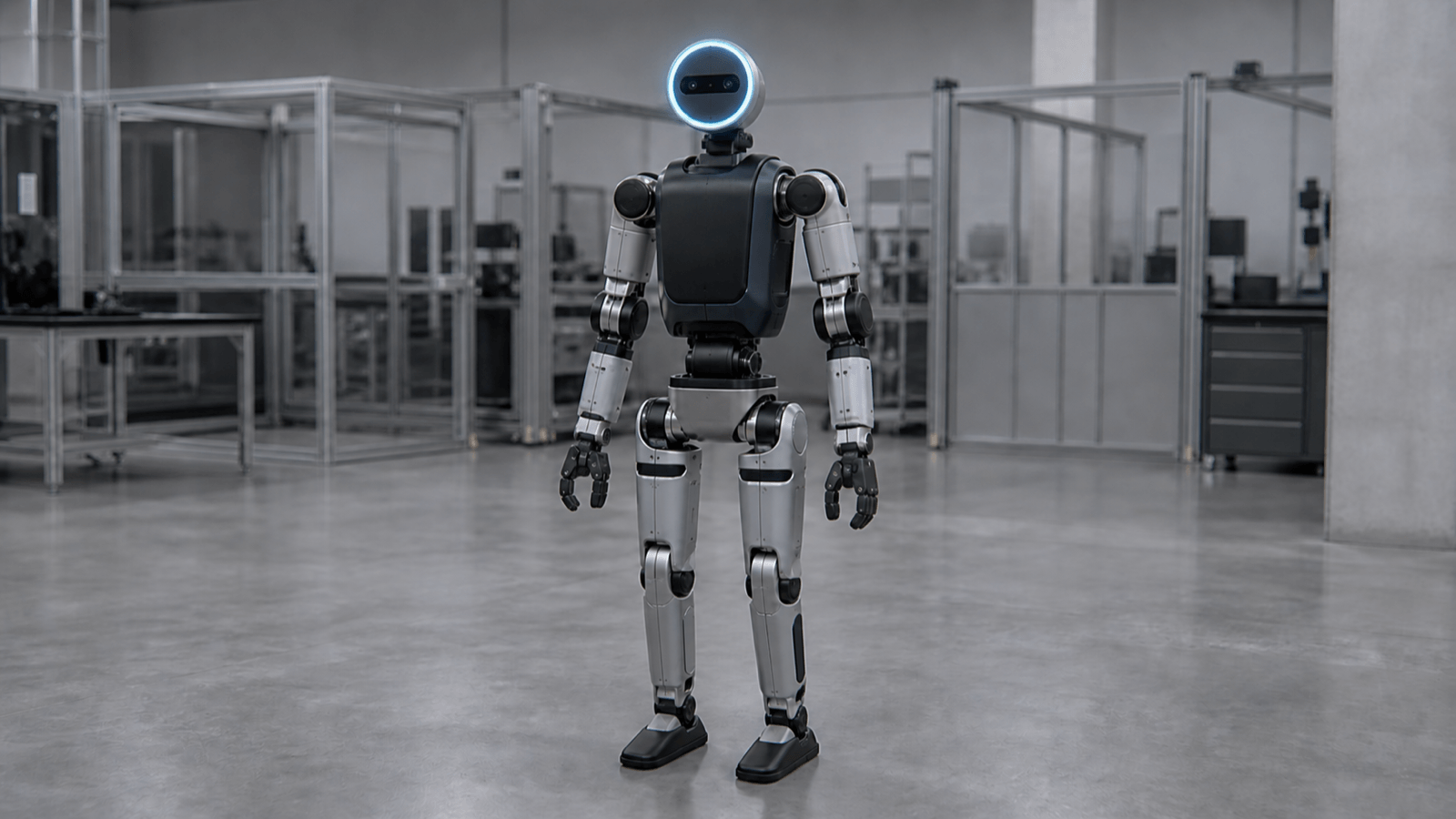
AI-generated editorial illustration. Not documentary evidence.
1. Identity and current status
Atlas is Boston Dynamics’ fully electric industrial humanoid. The name previously belonged to a hydraulic research robot famous for parkour and backflips, but the current machine is a separate product-oriented generation. Boston Dynamics unveiled a production version at CES 2026 with a published specification sheet, began manufacturing at its Massachusetts headquarters, and said every 2026 deployment allocation was committed to Hyundai and Google DeepMind. As of September 1, 2026, the most accurate status is Pilot: production hardware exists and field testing has begun, but customer access is selective and no sustained industrial outcome has been published.
Version discipline is essential. The white electric development robot tested at Hyundai in 2025 and teleoperated onstage at CES is not identical to the blue product version shown at the same event. Associated Press reporting notes that the moving CES prototype introduced a static product model with a different appearance. Boston Dynamics later presented the production Atlas publicly at the 2026 FIFA World Cup. This profile uses product-version specifications and treats earlier electric-machine demonstrations as development evidence, not proof that final production units have reproduced every behavior.
2. Core specifications
| Field | Production Atlas specification | Evidence boundary |
|---|---|---|
| Height | 1.9 m (6.2 ft) | Boston Dynamics product specification |
| Weight | 90 kg (198 lb) | Boston Dynamics product specification |
| Total degrees of freedom | 56 | Most joints are described as fully rotational; joint-by-joint allocation is not published |
| Payload | 50 kg instantaneous; 30 kg sustained; 20 kg one-handed | Company ratings; test posture, duration, and safety factor are not disclosed |
| Speed | Not publicly disclosed | No rated walking, task, or joint speed is published |
| Runtime | 4 hours; 2 hours with heavy lifting | Company ratings; duty cycle and test procedure are not published |
| Sensors | 360° camera view; tactile fingers and palm; human detection | Exact camera count, tactile resolution, range, redundancy, and safety architecture are not public |
| Compute | Not publicly disclosed | CBS reported Nvidia chips in a development Atlas; the production computer is unspecified |
| Battery | Self-swappable; 3-minute swap; 1.5-hour charge; 110 V with optional 220 V | Chemistry, capacity, cycle life, and number of packs supplied are not public |
| Product version | Production Atlas, unveiled January 2026 | Do not mix with hydraulic Atlas or the 2024–2025 electric development robot |
Additional published ratings include a 2.3 m reach, IP67 ingress protection, and an operating range from −20°C to 40°C. The robot supports autonomous, VR-teleoperated, and tablet-control modes. All figures come from Boston Dynamics’ December 2025 sales sheet, not an independent certification report.
3. Product position
Atlas is an enterprise automation system for factories and warehouses, not a consumer robot or developer kit. Boston Dynamics identifies part sequencing, machine tending, order building, material handling, and order fulfilment as target applications. Its unusual continuously rotating joints let the robot reorient its torso and limbs without copying human movement, while its human-scale reach allows it to use workstations designed for people.
The first target—automotive part sequencing—is deliberately narrow. Workers currently take variant-specific parts from supplier containers and place them in the order required by an assembly line. The task combines perception, repeated lifting, squatting, turning, grasping, and recovery from shifted objects. It offers a more measurable starting point than “general labor,” yet still tests whether a mobile manipulator can deliver useful throughput without expensive fixed automation.
Boston Dynamics also sells an operating system around the robot. The Atlas product page says Orbit will connect Atlas to manufacturing execution and warehouse-management systems, supervise work, and expose fleet metrics. That enterprise integration and the company’s field-service experience with Spot and Stretch may matter more to buyers than spectacular movement. The current limitation is that Atlas has not yet demonstrated those claims across an independently reported customer fleet.
4. Publicly claimed capabilities
Company claim: Boston Dynamics says Atlas can learn an application-specific task in less than a day, share a learned skill across a fleet, work autonomously with minimal supervision, and continue operating by navigating to a station and replacing its own battery. It lists barcode and RFID integration, human detection, fenceless guarding, modular field-replaceable components, and a future customer self-repair certification.
The company has shown development Atlases sequencing automotive parts, recovering dropped objects, carrying heavy items, walking, running, and using whole-body movement. It says these behaviors combine reinforcement learning in simulation, teleoperated demonstrations, machine-learning perception, large behavior models, motion capture, and conventional controls. The 2026 product launch added a planned Google DeepMind partnership to test Gemini Robotics foundation models with an Atlas fleet. The announcement describes joint research beginning in 2026; it does not establish that Gemini models already control shipping robots.
In July, the production Atlas delivered a ceremonial match ball and performed trained celebrations during a live World Cup halftime event. Boston Dynamics says those behaviors used a reinforcement-learning whole-body-control pipeline. The event confirms a product-version robot can execute a prepared public routine, but a short choreographed performance is not evidence of warehouse autonomy, payload endurance, or shift reliability.
5. Verified capabilities
Independent observation supports real mobility and selected autonomous manipulation, with important version limits. AP watched the electric development prototype rise from the floor and walk fluidly for several minutes at CES, while reporting that an engineer teleoperated that performance. It was a live mobility demonstration, not autonomous product validation.
CBS News and 60 Minutes observed an electric Atlas sorting roof racks at Hyundai’s Georgia plant without human help during the demonstrated sequence. The report also documented VR teleoperation used to create training data and thousands of simulated robots learning motions. That is stronger evidence than an edited company video because reporters observed the task at a named factory. It still provides no run duration, trial count, success rate, recovery rate, cycle time, safety record, or proof that the final production version performed the same test.
Hyundai independently confirms the production robot’s live World Cup appearance. The machine navigated a noisy public environment, handed over a ball, and completed prepared movements without a reported incident. This verifies controlled live performance. It does not verify the product’s 30 kg sustained load rating, four-hour runtime, autonomous battery swap, IP67 protection, task-teaching time, or minimal-supervision claim. Those remain manufacturer specifications or demonstrations until customers publish repeatable results.
6. Software and developer access
Atlas supports three operating modes—autonomous, VR teleoperation, and tablet control—and is designed to connect through Orbit to MES, WMS, barcode, and RFID systems. Boston Dynamics says skills can be distributed across a fleet. These are customer-facing integration concepts, but detailed Atlas interface documentation is not public.
There is no public Atlas SDK, API reference, simulator, model checkpoint, low-level joint interface, safety API, licensing schedule, or developer purchase program. Boston Dynamics’ public developer documentation is currently framed around Spot. Atlas configuration, training, integration, and support are provided through direct engagement with selected enterprise customers. Google DeepMind’s role is research collaboration, not an open model offering for Atlas owners.
7. Pricing and availability
Pricing is Not publicly disclosed. Boston Dynamics publishes no list price, lease rate, Robotics-as-a-Service fee, standard configuration, warranty, included battery count, service charge, delivery term, or regional sales schedule. The only route is a sales-contact form followed by use-case evaluation, training, integration, and adoption.
The January 2026 launch announcement said every 2026 deployment was committed to Hyundai’s Robot Metaplant Application Center and Google DeepMind, with additional customers planned for 2027. That indicates limited production rather than general availability. Hyundai’s longer roadmap says RMAC-trained Atlas robots will begin operational sequencing at Hyundai Motor Group Metaplant America in 2028 and expand toward component assembly in 2030. These dates describe staged validation and planned deployment, not current availability to ordinary buyers.
8. Deployment evidence
The strongest industrial evidence is the 2025 Hyundai field test observed by CBS. Atlas practiced autonomous roof-rack sorting in the parts warehouse at Hyundai’s plant near Savannah. Boston Dynamics calls this its first deployment; the safer classification is a field pilot, because it was a test conducted for evaluation and executive review, with no disclosed productive hours or business result.
The 2026 commitments have two different purposes. Hyundai’s RMAC fleet is intended to train and validate robots before plant deployment. Google DeepMind’s fleet supports joint AI research. Neither is yet a public case study of production work. Hyundai’s stated 2028 HMGMA plan begins with validated sequencing processes, while 2030 is the target for more complex assembly. Fleet size, unit delivery status, uptime, intervention, injuries, cycle time, and return on investment remain undisclosed.
The World Cup appearance is a verified deployment into a live event environment, but it is not an industrial deployment. It demonstrates that the production body can travel, execute a rehearsed routine, and interact briefly with people under controlled event planning. It should not be used to infer factory productivity.
9. Editorial assessment
Atlas is currently best suited to closely supported enterprise pilots where a high-value material-handling task justifies intensive integration. Its strongest evidence is the combination of a complete product specification, real production-version hardware, an observed factory test, and a manufacturer with established commercial robot operations. The payload ratings, self-swapping battery, serviceable modules, wide joint rotation, and Orbit integration address practical problems that many humanoid announcements leave vague.
The largest gap is operational proof for the production version. Boston Dynamics has not published sustained throughput, intervention rates, failure modes, safety validation, battery-swap reliability, fleet size, service labor, or customer economics. The final product’s most visible live performance was choreographed; the strongest factory observation involved a development robot. A multi-month customer report with task volume, uptime, interventions, safety events, maintenance hours, and cost would materially change the assessment. Until then, Atlas is a credible industrial pilot and limited-production platform—not a generally available autonomous worker.
10. Update history
- 2026-09-01: Profile created. Status set to Pilot because production hardware and field tests exist, while customer-scale industrial results and general availability do not.
- 2026-07-05: The production Atlas completed a live World Cup halftime appearance.
- 2026-06-14: CBS republished its on-site report documenting Atlas’s first Hyundai factory test.
- 2026-01-05: Boston Dynamics unveiled the production Atlas, began manufacturing, and announced 2026 allocations to Hyundai RMAC and Google DeepMind.
- 2025-12-23: Boston Dynamics dated the production Atlas sales specification sheet.
- 2025 fall: An electric development Atlas performed its first reported field test at Hyundai’s Georgia factory.
- 2024-04-17: Boston Dynamics introduced the fully electric Atlas development generation after retiring hydraulic Atlas.
11. Sources & evidence
- Atlas product page — Boston Dynamics, primary live product page, undated, accessed 2026-09-01.
- Atlas specifications — Boston Dynamics, primary technical sales sheet, dated 2025-12-23, accessed 2026-09-01.
- Boston Dynamics unveils new Atlas robot — Boston Dynamics, primary product announcement, 2026-01-05, accessed 2026-09-01.
- Boston Dynamics and Google DeepMind form Atlas AI partnership — Boston Dynamics, primary partnership announcement, 2026-01-05, accessed 2026-09-01.
- Hyundai Motor Group announces AI Robotics strategy — Hyundai Motor Group, primary deployment roadmap, 2026-01-05, accessed 2026-09-01.
- Boston Dynamics’ Atlas is learning to work in a factory — CBS News / 60 Minutes, independent on-site reporting, first published 2026-01-04 and updated 2026-06-14, accessed 2026-09-01.
- Hyundai and Boston Dynamics unveil Atlas at CES — Associated Press, independent live-event reporting, 2026-01-05, accessed 2026-09-01.
- Hyundai brings production Atlas to the 2026 FIFA World Cup — Hyundai Motor Company, primary partner event report, 2026-07-05, accessed 2026-09-01.
Boston Dynamics Atlas — sources
- Article slug:
boston-dynamics-atlas - Access date for all web sources: 2026-09-01
S1. Atlas product page
- Publisher: Boston Dynamics
- URL: https://bostondynamics.com/products/atlas/
- Publication date: Undated live page
- Source type: Primary product page
- Supports: current product identity; target industrial applications; Orbit positioning; key dimensions, ratings, sensing, protection, sales journey, and Hyundai pilot language.
- Boundary: product claims are not independent performance verification.
S2. Atlas specifications
- Publisher: Boston Dynamics
- URL: https://bostondynamics.com/wp-content/uploads/2026/01/atlas-spec-sheet.pdf
- Publication date: 2025-12-23, as printed on the sheet
- Source type: Primary technical sales document
- Supports: height, weight, DoF, payload ratings, reach, runtime, swap and charge times, power requirements, sensing, serviceability, operating modes, IP rating, and temperature range.
- Boundary: the document does not provide test protocols, certification reports, computer specifications, battery chemistry, or joint-level details.
S3. Boston Dynamics unveils new Atlas robot
- Publisher: Boston Dynamics
- URL: https://bostondynamics.com/blog/boston-dynamics-unveils-new-atlas-robot-to-revolutionize-industry/
- Publication date: 2026-01-05
- Source type: Primary product announcement
- Supports: production-version launch; immediate manufacturing statement; 2026 allocations to Hyundai RMAC and Google DeepMind; additional-customer plan; enterprise functions and integrations; Hyundai Mobis actuator supply.
- Boundary: availability and performance statements are company plans or claims; “committed” deployments do not confirm delivery or productive operation.
S4. Boston Dynamics and Google DeepMind form Atlas AI partnership
- Publisher: Boston Dynamics
- URL: https://bostondynamics.com/blog/boston-dynamics-google-deepmind-form-new-ai-partnership/
- Publication date: 2026-01-05
- Source type: Primary partnership announcement
- Supports: planned joint research using Gemini Robotics foundation models and Atlas fleets at both companies.
- Boundary: does not establish that Gemini models currently operate deployed Atlas units or that models will be open to customers.
S5. Hyundai Motor Group announces AI Robotics strategy
- Publisher: Hyundai Motor Group
- URL: https://www.hyundai.com/content/hyundai/worldwide/en/newsroom/detail/hyundai-motor-group-announces-ai-robotics-strategy-to-lead-human-centered-robotics-era-at-ces-2026-0000001100.html
- Publication date: 2026-01-05
- Source type: Primary parent-company deployment roadmap
- Supports: production Atlas positioning and specifications; RMAC training role; 2028 sequencing plan at HMGMA; 2030 assembly target; staged validation and manufacturing-capacity goal.
- Boundary: roadmap dates and scale are forward-looking company plans, not completed deployments.
S6. Boston Dynamics’ Atlas is learning to work in a factory
- Publisher: CBS News / 60 Minutes
- URL: https://www.cbsnews.com/amp/news/boston-dynamics-ai-powered-humanoid-robot-learning-factory-work-60-minutes-transcript/
- Publication date: First published 2026-01-04; updated 2026-06-14
- Source type: Independent on-site reporting
- Supports: observed Atlas test at Hyundai’s Georgia plant; autonomous roof-rack sorting during the observed sequence; VR demonstration collection; simulation training; development-robot mobility.
- Boundary: does not disclose duration, trial count, success rate, intervention rate, throughput, or production-version equivalence.
S7. Hyundai and Boston Dynamics unveil Atlas at CES
- Publisher: Associated Press
- URL: https://apnews.com/article/ces-humanoid-robots-atlas-hyundai-boston-dynamics-8de7b2470c23f5f22441ad1ad7555136
- Publication date: 2026-01-05
- Source type: Independent live-event reporting
- Supports: live walking of the electric development prototype; teleoperation disclosure; separation between the moving prototype and the static product model; planned Hyundai use.
- Boundary: live CES movement was remotely controlled and does not verify product-version autonomy.
S8. Hyundai brings production Atlas to the 2026 FIFA World Cup
- Publisher: Hyundai Motor Company
- URL: https://www.hyundai.com/content/hyundai/worldwide/en/newsroom/detail/0000001215.html
- Publication date: 2026-07-05
- Source type: Primary partner event report and official media source
- Supports: production Atlas’s live match-ball handoff and prepared goal celebrations; event location and date; official product photographs.
- Boundary: a rehearsed public performance does not establish industrial productivity or sustained autonomy.