
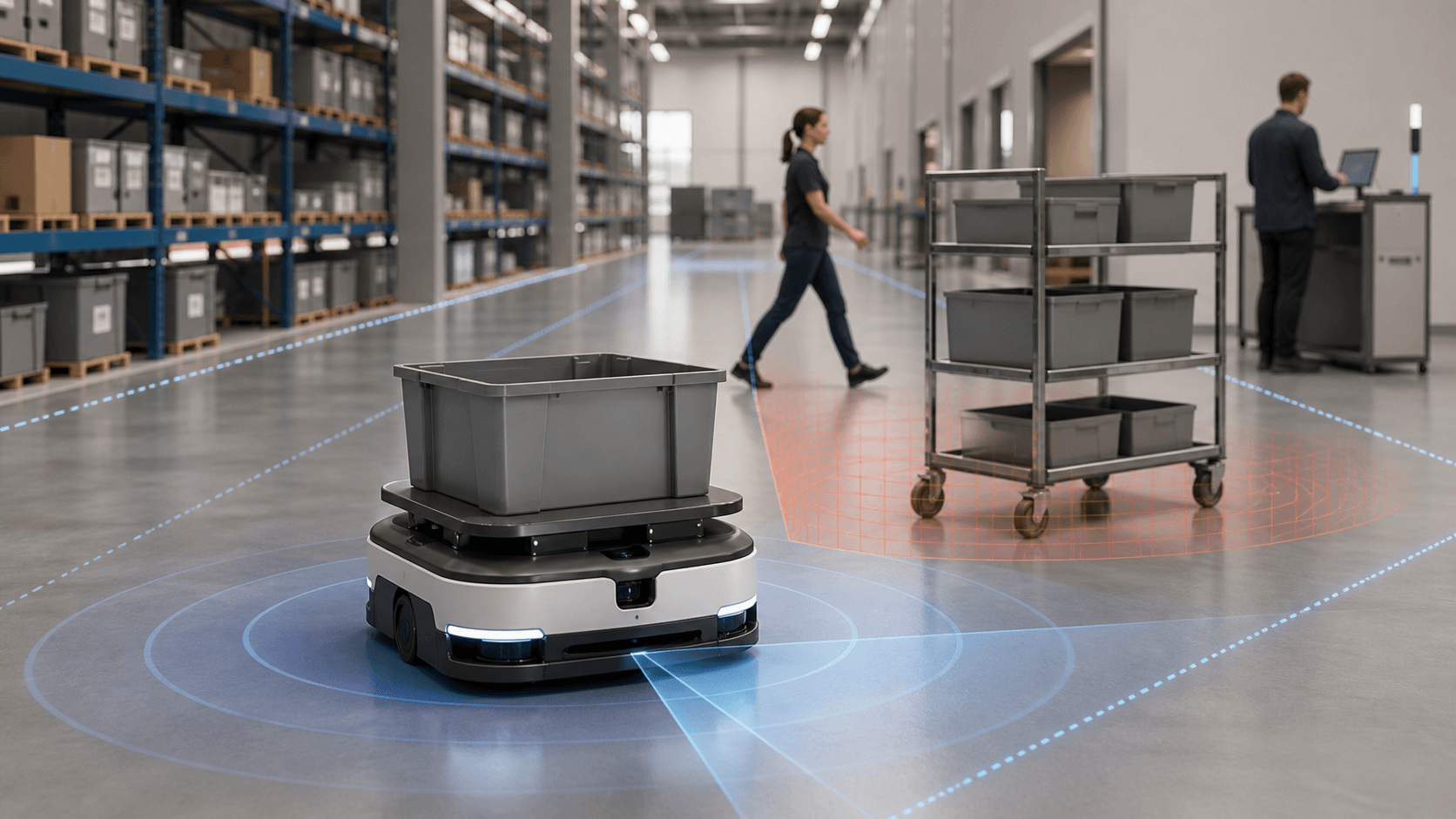
Autonomy describes the robot’s responsibility inside a specific task and environment, including where human supervision or assistance remains. AI-generated editorial illustration. It explains the concept and does not depict documented evidence.
1. In one sentence
Robot autonomy is the degree to which a machine can complete a defined task from its current state and sensor information without a person continuously choosing its actions.
2. Why you need to understand it
“Autonomous” is one of the most overloaded words in robotics. It can describe a floor-cleaning robot selecting a route, a warehouse vehicle moving totes, or a research system attempting a long manipulation task. These systems may all make some decisions without direct control, yet the scope and reliability of that independence can differ dramatically.
A robot may navigate autonomously but require a person to load it. It may complete routine missions alone but call a remote operator when a doorway is blocked. It may work without intervention inside a mapped warehouse and fail in an unfamiliar building. Saying only that the robot is autonomous removes the task, environment and human support that give the word meaning.
Readers need a more precise framework. When a company announces autonomy, ask: autonomous at what task, under which conditions, for how long, with what monitoring, and what happens when the robot cannot proceed?
3. The core idea
The International Federation of Robotics cites ISO 8373 in defining a degree of autonomy as the ability to perform intended tasks based on current state and sensing without human intervention. The important words are intended tasks. Autonomy is attached to what the system is expected to do, not to an unlimited claim about everything the machine could encounter.
Autonomy is also gradual. A person might directly steer every movement. A robot might follow a route while a person approves exceptions. A system might plan and execute an entire routine mission but request help when confidence falls. Human involvement does not automatically erase autonomy; it defines its boundary.
NIST’s Autonomy Levels for Unmanned Systems framework, known as ALFUS, offers a useful way to resist a single universal ladder. It characterizes autonomous capability using three connected dimensions: mission complexity, environmental complexity and human independence. A system that completes a simple task in a structured environment with little assistance is not automatically more capable than one handling a harder environment with occasional support.
Autonomy therefore belongs to a complete operating description. The same robot can have different degrees of autonomy in different modes. Its navigation may be mature, its manipulation may be supervised, and its maintenance may be entirely manual.
4. How it works
Consider a mobile robot assigned to move a tote from storage to a packing station.
- A human or software system assigns the mission. The robot receives a destination, payload condition and operational rules. Human intent still defines the job even if the robot chooses the motions.
- The robot estimates its situation. Sensors and perception software estimate position, obstacles, people, route availability and internal conditions such as battery charge.
- The robot plans within constraints. It selects a route and behavior that fit maps, traffic rules, safety zones and its physical limits.
- The robot acts and monitors progress. Controllers move the base while perception updates the world estimate. The system checks whether it remains on course and whether conditions still satisfy its operating rules.
- The robot handles or escalates exceptions. It may re-plan around a cart, wait for a person or return to charge. If the situation exceeds its capabilities, it stops, requests remote assistance or hands the task back to a human.
The last step is part of autonomy, not proof that autonomy failed as a concept. A well-designed system should know some boundaries and transition safely when it reaches them. The meaningful measure is how often assistance occurs, why it occurs, how quickly service recovers and whether the rules were defined before deployment.
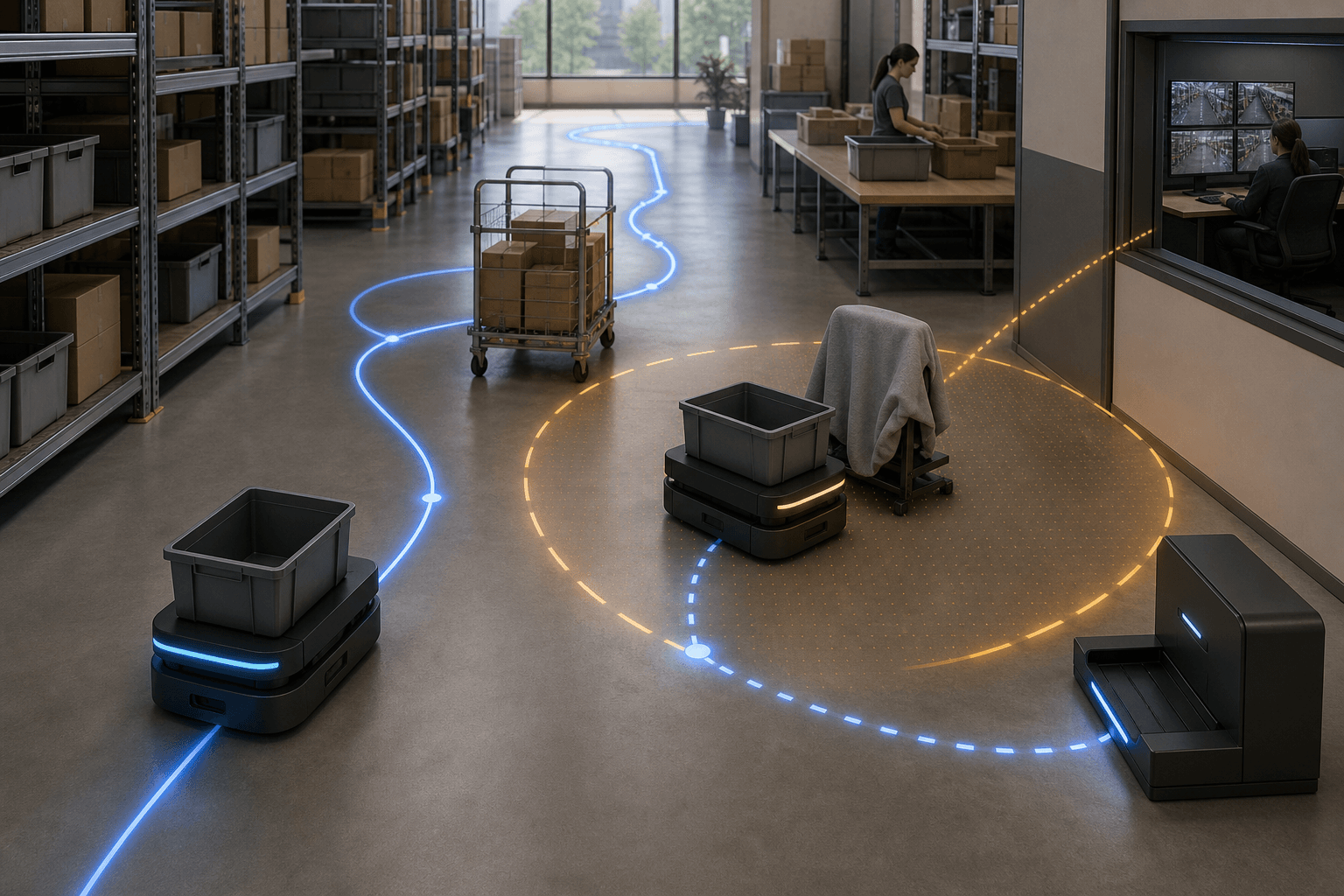
Autonomous operation includes mission assignment, sensing, planning, action, monitoring and a defined response when the system reaches its limits. AI-generated editorial illustration. It explains the concept and does not depict documented evidence.
5. A real-world example
Robust AI and ShipLab Carter deployment — Announced pilot. On July 8, 2026, Robust AI announced a partnership to deploy Carter collaborative mobile robots at ShipLab’s fulfillment facility in Vista, California. The first phase was described as a pilot for moving totes between fulfillment and packing stations, with an initial go-live planned for July 2026.
The announcement framed expansion as “Crawl, Walk, Run.” ShipLab would validate performance at each phase before moving to a broader fleet and more complex picking applications. Payments under the robot-as-a-service arrangement were described as deferred until jointly defined performance targets were confirmed.
This is a useful autonomy example because it ties capability to a bounded workflow. Moving a tote between known stations does not require the robot to understand every warehouse task. People still define stations, processes, performance targets and expansion decisions. The robot can nevertheless have meaningful autonomy in route selection, motion and expected obstacle handling inside that workflow.
The evidence is a vendor announcement containing quotations from both Robust AI and ShipLab. It stated that the initial go-live was planned; it did not provide later operational results, intervention rates or independent confirmation that the pilot completed. Product capability, performance and future expansion statements are therefore Company claim evidence. The correct status is announced pilot, not verified scaled deployment.
6. Common misunderstandings
“Autonomous means no humans are involved”
Humans choose goals, prepare sites, maintain machines, monitor fleets and handle exceptions. A robot can autonomously execute part of a workflow while people remain responsible for the larger operation. The useful question is which decisions the robot makes and which still belong to people.
“Autonomy is one ladder from zero to fully autonomous”
A single ladder hides task and environment. A robot may be highly independent at corridor navigation but unable to open an unfamiliar door. NIST’s multidimensional framing shows why human independence must be considered alongside mission and environmental complexity.
“Remote assistance means the robot is only teleoperated”
Occasional assistance differs from continuous control. If a robot normally senses, plans and acts independently but asks a person to resolve rare exceptions, the intervention rate and scope should be reported. Calling both arrangements “teleoperation” would erase a meaningful operational distinction.
“One autonomous demonstration proves deployment readiness”
A successful run shows that the system completed one attempt under observed conditions. Deployment evidence needs repeated operation, defined failures, intervention data, uptime and performance inside the customer workflow.
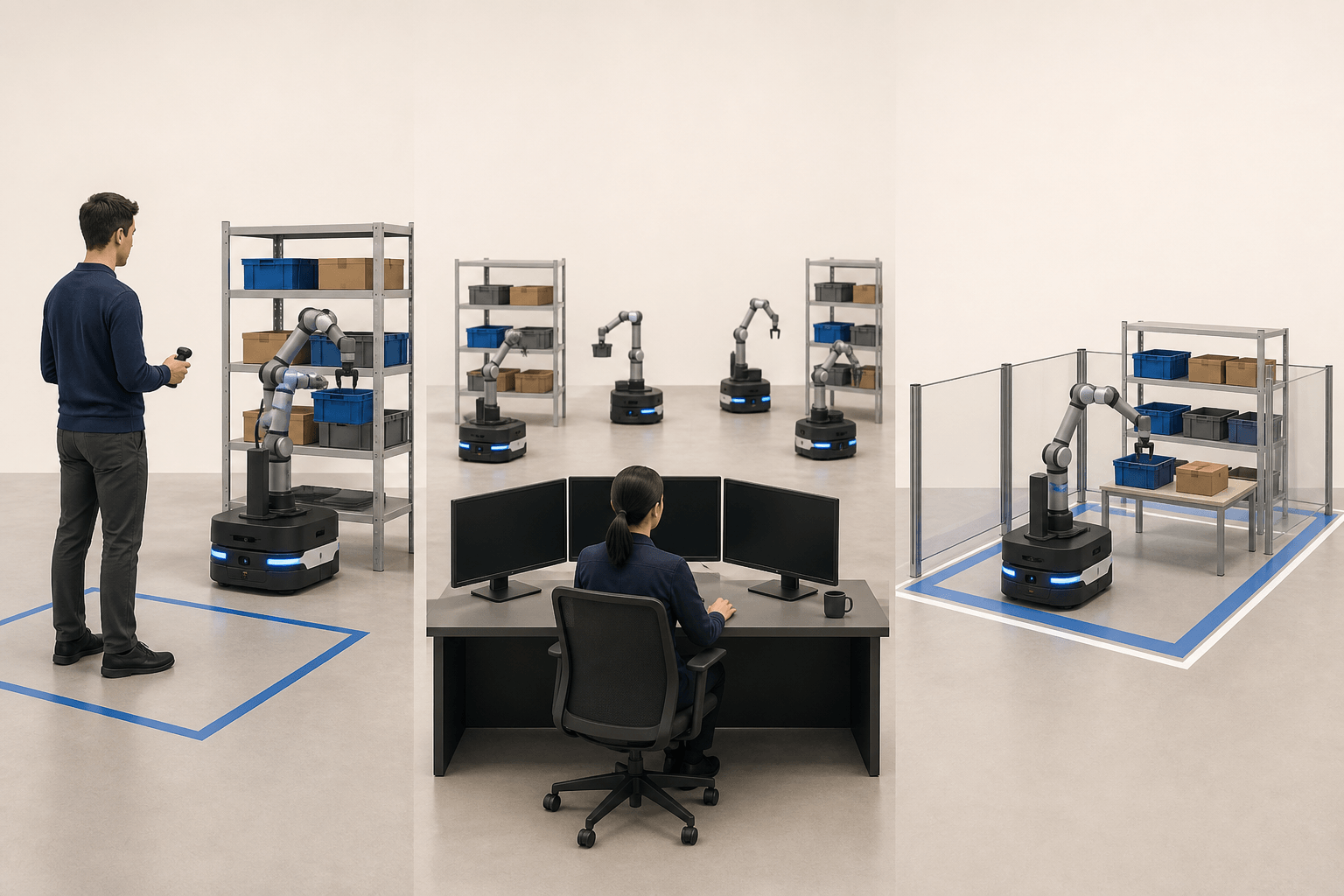
Human involvement can range from continuous control to occasional exception handling; those modes should not share one unqualified label. AI-generated editorial illustration. It explains the concept and does not depict documented evidence.
7. Current limitations
Autonomy remains limited by perception and uncertainty. Robots cannot plan safely around conditions they fail to detect or interpret. Dust, glare, clutter, moved equipment and unusual human behavior can push a system outside its expected operating environment.
Long missions compound errors. Localization can drift, a delayed task can create traffic conflicts, or a partial failure can invalidate later steps. Greater mission complexity increases the number of states, dependencies and recovery paths the system must handle.
Human support is difficult to measure consistently. A vendor may exclude setup, mapping, maintenance or remote recovery from an autonomy claim. Two deployments described as autonomous can therefore require very different labor. Useful reporting should include interventions per mission or operating hour, reasons for assistance and time needed to recover.
Safety boundaries can also reduce apparent independence. A system may deliberately stop in uncertain situations rather than improvise. That conservative behavior can be appropriate, but it affects throughput and still requires an operational response. Autonomy should be evaluated together with reliability, safety, service requirements and the cost of exceptions.
8. Key takeaways
- Autonomy applies to a defined task and operating environment, not to an entire robot without qualification.
- Mission complexity, environmental complexity and human independence must be considered together.
- Occasional human assistance is different from continuous teleoperation and should be measured explicitly.
- Safe stopping and escalation are legitimate parts of an autonomous system’s design.
- A pilot announcement is not evidence of scaled deployment; intervention and operational results are needed.
9. Where to go next
This completes the six-part Beginner guide path. The recommended order is What Makes a Machine a Robot?, What Is Embodied AI—and Why Does a Body Change the Problem?, How Robots Sense the World—and Why Sensing Is Not Understanding, How Feedback Control Turns Robot Commands Into Reliable Motion, How Robots Learn From Human Demonstrations, then this guide. Continue into Technology articles for deeper analysis of models, data and control methods.
10. Sources & evidence
- International Federation of Robotics: Service Robots — ISO-derived autonomy definition and service-robot context.
- Toward a Generic Model for Autonomy Levels for Unmanned Systems — NIST ALFUS foundation paper.
- ALFUS Framework Volume I: Terminology Version 2.0 — NIST terminology publication.
- ALFUS Framework Volume II: Framework Models — NIST contextual autonomous capability model.
- Robust AI Introduces “Crawl, Walk, Run” Automation Model with ShipLab Deployment — company announcement; deployment and performance statements are company claims.
Sources — What Robot Autonomy Really Means
Access date: September 2, 2026
1. Service Robots
- Institution: International Federation of Robotics
- URL: https://ifr.org/service-robots
- Publication date: Continuously updated reference page
- Source type: ISO-derived industry definition
- Supports: Degree-of-autonomy definition, intended-task boundary, partial-to-full autonomy range and distinction from robotic devices.
2. Toward a Generic Model for Autonomy Levels for Unmanned Systems
- Authors: Hui-Min Huang, Elena R. Messina and James S. Albus
- Institution: National Institute of Standards and Technology
- URL: https://www.nist.gov/publications/toward-generic-model-autonomy-levels-unmanned-systems-alfus
- Publication date: August 18, 2003
- Source type: Government research framework paper
- Supports: Mission-specific autonomy characterization and the factors of task complexity, environmental complexity and human involvement.
3. ALFUS Framework Volume I: Terminology Version 2.0
- Author: Hui-Min Huang
- Institution: National Institute of Standards and Technology
- URL: https://www.nist.gov/publications/autonomy-levels-unmanned-systems-alfus-framework-volume-i-terminology-version-20
- Publication date: September 30, 2004
- Source type: NIST Special Publication 1011
- Supports: Terminology for autonomous capability, human independence, environment and mission.
4. ALFUS Framework Volume II: Framework Models Version 1.0
- Institution: National Institute of Standards and Technology
- URL: https://tsapps.nist.gov/publication/get_pdf.cfm?pub_id=823618
- Publication date: 2007
- Source type: NIST framework publication
- Supports: Contextual Autonomous Capability model and its mission-complexity, environmental-complexity and human-independence axes.
5. Robust AI Introduces “Crawl, Walk, Run” Automation Model with ShipLab Deployment
- Organizations: Robust AI and ShipLab
- URL: https://www.robust.ai/shiplab-deployment
- Publication date: July 8, 2026
- Source type: Company announcement with named customer quotation
- Supports: Partnership, tote-transport pilot, planned July 2026 go-live, phased validation, conditional expansion and commercial model.
- Attribution boundary: The source does not provide post-go-live results or independent deployment verification. Product capability and performance statements remain company claims.