
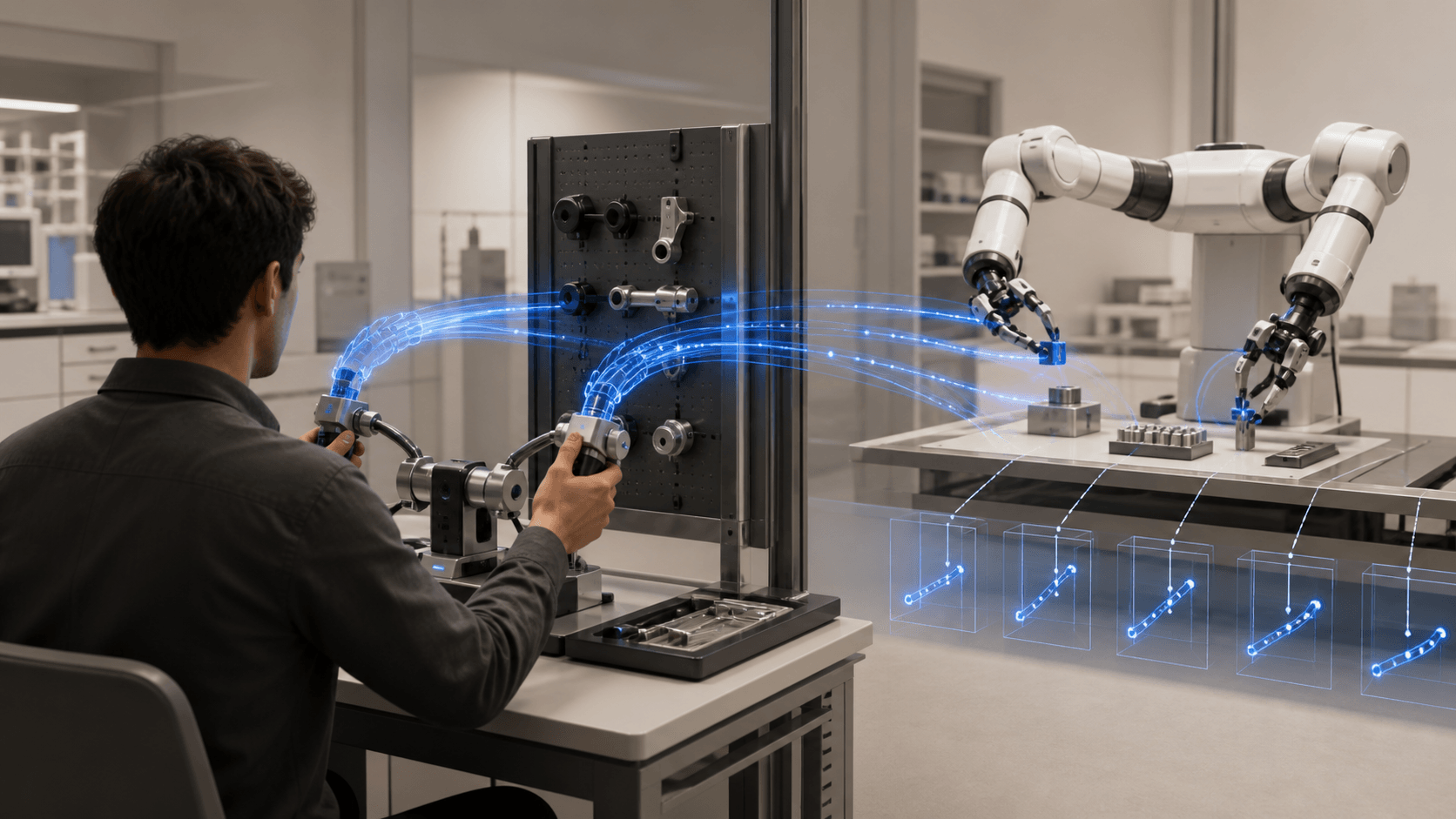
AI-generated editorial illustration. It explains human-to-robot demonstration capture and does not represent measured data.
1. The central question
A robot-learning dataset is often described by its number of hours or trajectories. That description hides the person who produced the actions and the interface through which those actions passed. A demonstrator may move miniature leader arms, wear a headset, have their hands tracked by cameras, or steer a mobile platform while coordinating two grippers. Each interface makes some behaviors easy and others awkward or impossible.
The central question is therefore: how does a teleoperation interface shape the intelligence learned from its data? The core conclusion is that the interface acts as a filter. It determines what the operator can perceive, how human motion is mapped onto the robot, which corrections can be made in time, and what errors enter the recording. A better interface does not merely collect data faster. It changes the distribution of behaviors available for a policy to learn.
2. Conceptual foundation
In imitation learning, a demonstration usually contains synchronized observations and actions. Observations can include camera frames, joint positions and gripper state. Actions may be target joint angles, end-effector poses or velocities. A policy learns correlations between the situation and the demonstrator’s command. It does not directly observe the operator’s intention, discomfort or abandoned alternatives.
Teleoperation closes a control loop through a human: the operator sees or feels the robot’s state, issues a command through an input device, and watches the result. Kinematic retargeting translates motion from the operator or controller into motion that respects the robot’s different dimensions and joint limits. Embodiment mismatch is the gap between the controlling body and the controlled machine. Even a highly intuitive interface must decide how a human wrist maps to a robot wrist, how a hand maps to a two-finger gripper, and what happens near unreachable poses.
3. How the system works
The pipeline begins with sensing the operator. A leader arm measures its joints; a headset estimates head and hand pose; a motion-capture system tracks markers; a handheld device supplies a desired gripper pose. Software transforms those measurements into the robot’s coordinate system, filters noise, enforces limits and sends commands to the robot controller. Cameras stream the result back to the operator. Meanwhile, a recorder timestamps observations, robot states and actions to create training trajectories.
Every stage can alter the data. Scaling can turn a large human movement into a small robot movement. Filtering can smooth tremor but erase quick corrections. Network delay can make the operator overshoot. A poor viewpoint can hide contact, causing hesitant probing actions. Safety limits can clip a command. If these effects recur across thousands of demonstrations, the policy may learn the interface’s habits alongside the task.
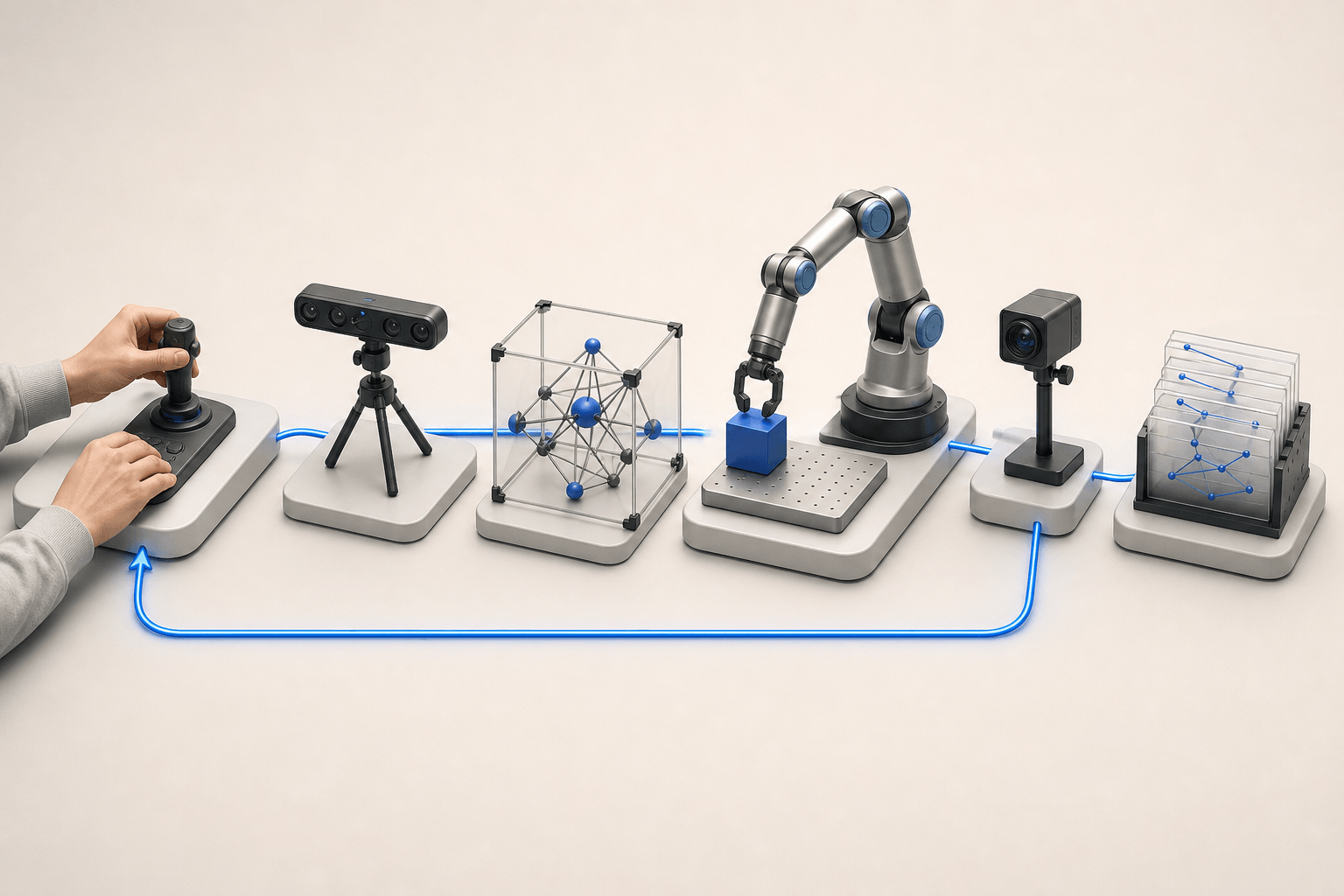
AI-generated editorial illustration. It explains the teleoperation data pipeline and does not represent measured data.
4. Major approaches
Leader–follower hardware. The operator physically moves smaller or backdrivable leader arms whose joints correspond closely to the robot’s follower arms. ALOHA and ALOHA 2 use this approach for bimanual manipulation. Direct correspondence reduces the retargeting problem and gives the operator a concrete sense of the reachable workspace. It also ties collection to specialized hardware and can constrain motion to what the leader mechanism permits.
Immersive headset and hand tracking. Systems such as Open-TeleVision provide stereoscopic robot-centric video while tracking the operator’s head, arms and hands. This can make control portable and allow the operator to perceive the scene from the robot’s viewpoint. The mapping is less mechanically direct: software must retarget human anatomy to different robot kinematics, and tracking accuracy, occlusion and end-to-end latency become central.
Whole-body mobile teleoperation. Mobile ALOHA adds a wheeled base to bimanual manipulation, requiring coordinated commands for locomotion, torso position and both arms. It can capture tasks that cross a room or span several work surfaces. The operator must manage more degrees of freedom, and small coordination failures can affect an entire long-horizon trajectory.
Active-view teleoperation. AV-ALOHA gives the operator control of a dedicated stereo camera arm through head and body movement while manipulating with two other arms. Open-TeleVision similarly emphasizes active visual feedback. This approach records not only how to act, but where to look. It can expose contact hidden from fixed cameras, at the cost of another control stream, additional hardware and a more complex learning problem.
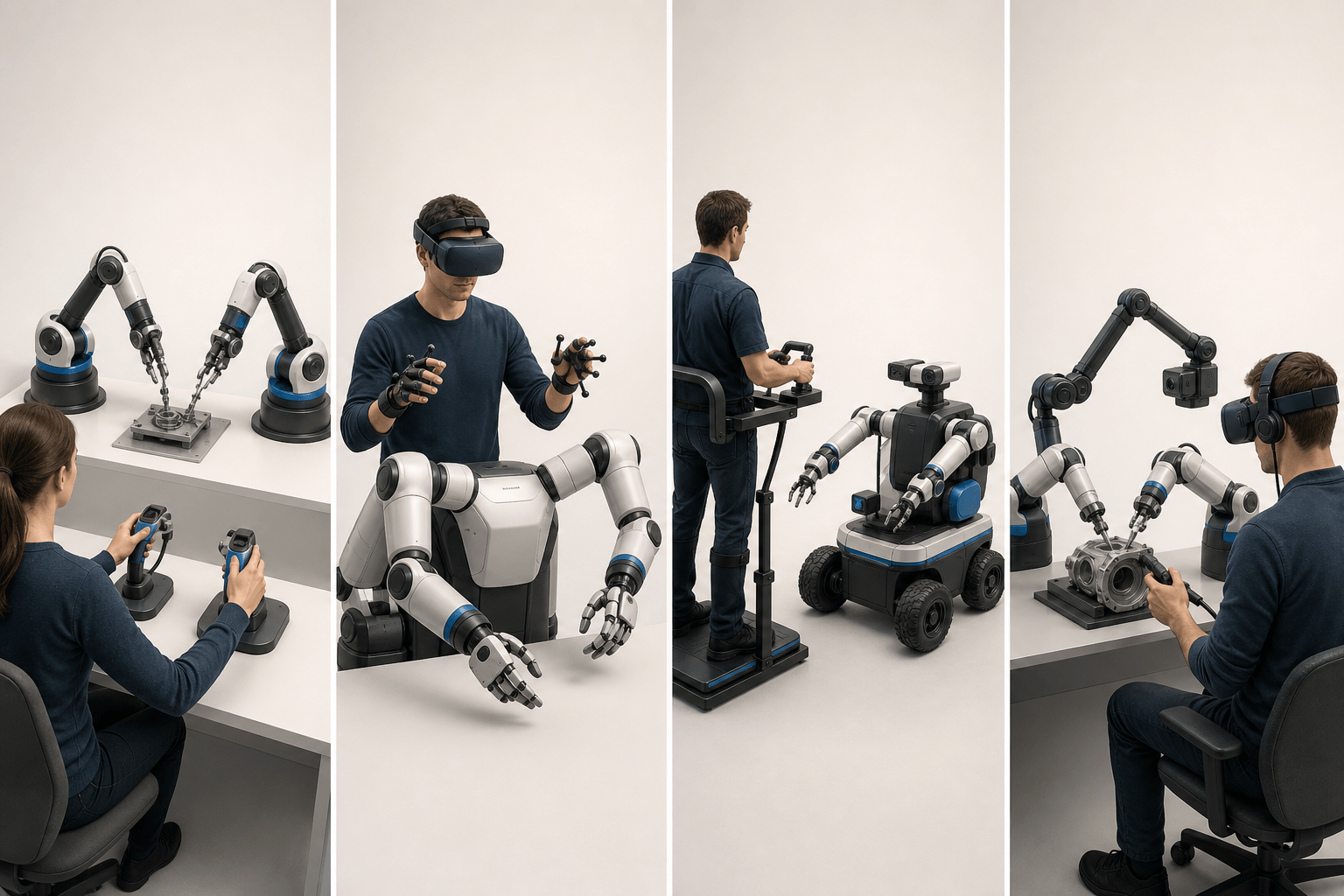
AI-generated editorial illustration. It compares teleoperation interface families and does not represent measured data.
5. Evidence and examples
ALOHA 2 was designed to improve the original platform’s performance, ergonomics and robustness, with open hardware designs, a construction tutorial and a system-identified MuJoCo model. Its importance is not a single benchmark number; it is the attempt to make bimanual data collection repeatable enough for larger research programs. The corresponding leader–follower geometry gives operators direct control over two robot arms while limiting the mismatch between input device and follower.
DROID tests a different dimension: distributed scale. Its authors report 76,000 trajectories, or 350 hours of interaction, collected by 50 operators across 564 scenes and 84 tasks over 12 months in North America, Asia and Europe. Training experiments reported improved policy performance and generalization with DROID data. Those results support the value of environmental and operator diversity, while the standardized hardware and collection protocol show that large-scale diversity still requires strict interface coordination.
Open-TeleVision reports data collection and real-world imitation policies for four long-horizon precision tasks—can sorting, can insertion, folding and unloading—on two humanoid robots. AV-ALOHA targets a related perceptual bottleneck and reports advantages over fixed cameras on tasks with limited visibility. These are author-reported studies on selected systems, but together they show that viewpoint control can become part of the demonstrated skill rather than a passive recording choice.
Mobile ALOHA used 50 demonstrations per task and reported that co-training with existing static ALOHA data increased success by up to 90% under its experimental definition. The result should not be read as “50 demonstrations are enough” in general. It shows that interface-compatible prior data can help when the new system adds mobility and whole-body coordination.
6. Trade-offs
The first trade-off is fidelity versus accessibility. Mechanically matched leader arms can capture precise, contact-rich motion, but require dedicated equipment. Consumer headsets and tracking systems reduce mechanical infrastructure but move complexity into calibration, retargeting and latency.
The second is operator speed versus dataset diversity. An expert using a familiar rig may generate clean trajectories quickly, yet encode one preferred solution. More operators and sites increase variation but also introduce different habits, camera layouts, calibration quality and interpretations of success. Standardization removes some noise while potentially narrowing behavior.
The third is observability versus control burden. A fixed camera is simple and produces a consistent input distribution. An active camera can reveal occluded contacts, but the operator must coordinate gaze with manipulation and the learned policy must later reproduce that coordination. Whole-body systems have the same tension: mobility expands the task space while increasing fatigue and opportunities for timing errors.
Finally, hardware cost cannot be separated from labor. A cheaper rig that doubles demonstration time or creates more discarded trajectories may be more expensive per usable episode. Conversely, an elaborate interface may capture excellent data but be too difficult to deploy across many sites.
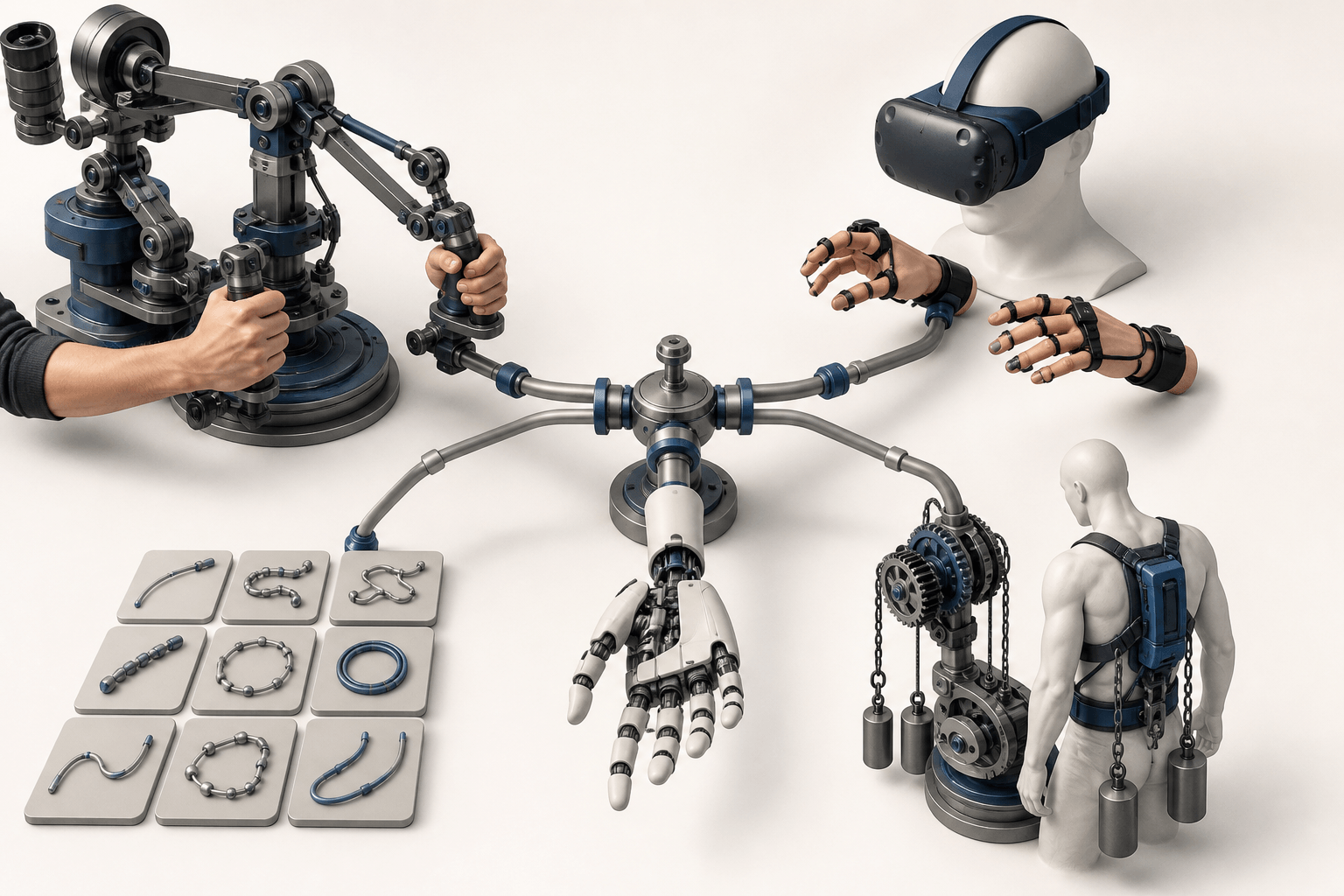
AI-generated editorial illustration. It explains interface and dataset trade-offs and does not represent measured data.
7. Current limitations
Teleoperation papers rarely report a common measure of demonstration quality. Task success, completion time, operator training, intervention count, discarded episodes and physical workload are measured inconsistently. Policy performance also folds together the interface, the dataset, the learning algorithm and the robot hardware, making causal attribution difficult.
Interfaces cannot eliminate embodiment mismatch. Human hands, robot grippers and dexterous hands have different joints, force limits and sensing. Visual feedback often dominates because affordable force feedback is difficult to reproduce. That leaves contact forces partially hidden from the operator and absent from many datasets. Long sessions introduce fatigue, while safety constraints and communication delays alter the trajectory in ways a policy may later imitate without understanding their cause.
8. Open questions
The field needs a practical definition of a “good” demonstration that extends beyond final success. Should quality include smoothness, recoveries, contact forces, time, operator effort or how much the trajectory improves a downstream policy? Can systems automatically identify when a trajectory is informative rather than merely successful?
Another open question is how to combine incompatible interfaces. A leader-arm dataset, a headset-retargeted dataset and human video do not share the same action semantics. Researchers need representations that preserve each source’s useful variation without treating interface artifacts as robot skills. Active vision also raises a deployment question: should the autonomous policy learn where to look, or should camera control remain a separate engineered subsystem?
9. Editorial synthesis
The most credible teleoperation systems are not those that feel most futuristic; they are those whose transformations and failure modes are explicit. Leader–follower rigs remain persuasive for precise bimanual data because the action mapping is tangible and reproducible. Immersive interfaces are valuable when portability, humanoid retargeting or active perception matters. Mobile and active-view systems are necessary when the task itself exceeds a fixed tabletop and fixed camera.
No interface is neutral. A useful dataset report should therefore describe the control device, retargeting, feedback view, latency, operator training, safety filtering and rejection criteria alongside hours and trajectories. The next step is not simply collecting more demonstrations. It is treating the human–machine interface as part of the learning system and measuring how its design changes what autonomous policies can do.
10. Key takeaways
- Teleoperation interfaces filter human intention into the subset of motions a robot can record and later imitate.
- Leader–follower systems reduce kinematic mismatch; headset systems improve portability and viewpoint immersion but rely more heavily on retargeting.
- Mobility and active vision expand the task space while increasing operator burden and policy complexity.
- Dataset scale does not replace interface documentation: operators, calibration, latency and rejection rules all shape the recorded distribution.
- Interface quality should ultimately be measured through both usable trajectories and downstream policy behavior.
11. Further reading
- How Robots Learn from Demonstrations — review the imitation-learning pipeline that consumes teleoperated trajectories.
- What Is Robot Training Data? — place demonstrations alongside simulation, synthetic data and autonomous experience.
- Why Robots Generate Actions in Chunks — see how policies turn recorded trajectories into coherent future motion.
12. Sources & evidence
- ALOHA 2 Team et al., ALOHA 2: An Enhanced Low-Cost Hardware for Bimanual Teleoperation, 2024.
- Khazatsky et al., DROID: A Large-Scale In-The-Wild Robot Manipulation Dataset, 2024; revised 2025.
- Cheng et al., Open-TeleVision: Teleoperation with Immersive Active Visual Feedback, 2024.
- Fu, Zhao and Finn, Mobile ALOHA: Learning Bimanual Mobile Manipulation with Low-Cost Whole-Body Teleoperation, 2024.
- Chuang et al., Active Vision Might Be All You Need, 2024; revised 2025.
Sources
Accessed: 2026-09-02
-
ALOHA 2: An Enhanced Low-Cost Hardware for Bimanual Teleoperation
ALOHA 2 Team et al. Submitted 2024-02-07.
https://arxiv.org/abs/2405.02292
Supports: leader–follower bimanual hardware, ergonomics and robustness goals, open hardware and simulator release. -
DROID: A Large-Scale In-The-Wild Robot Manipulation Dataset
Alexander Khazatsky et al. Submitted 2024-03-19; revised 2025-04-22; RSS 2024.
https://arxiv.org/abs/2403.12945
Supports: distributed collection scale, scene/task/operator diversity and policy experiments. -
Open-TeleVision: Teleoperation with Immersive Active Visual Feedback
Xuxin Cheng, Jialong Li, Shiqi Yang, Ge Yang and Xiaolong Wang. Submitted 2024-07-01.
https://arxiv.org/abs/2407.01512
Supports: immersive stereo feedback, human-to-robot motion mirroring and four-task real-world evidence. -
Mobile ALOHA: Learning Bimanual Mobile Manipulation with Low-Cost Whole-Body Teleoperation
Zipeng Fu, Tony Z. Zhao and Chelsea Finn. Submitted 2024-01-04; CoRL 2024.
https://arxiv.org/abs/2401.02117
https://mobile-aloha.github.io/
Supports: mobile whole-body teleoperation, co-training and reported task evidence. -
Active Vision Might Be All You Need: Exploring Active Vision in Bimanual Robotic Manipulation
Ian Chuang, Andrew Lee, Dechen Gao, M-Mahdi Naddaf-Sh and Iman Soltani. Submitted 2024-09-26; revised 2025-03-08.
https://arxiv.org/abs/2409.17435
Supports: fixed-view limitations, headset-controlled camera motion and active-view experiments.