
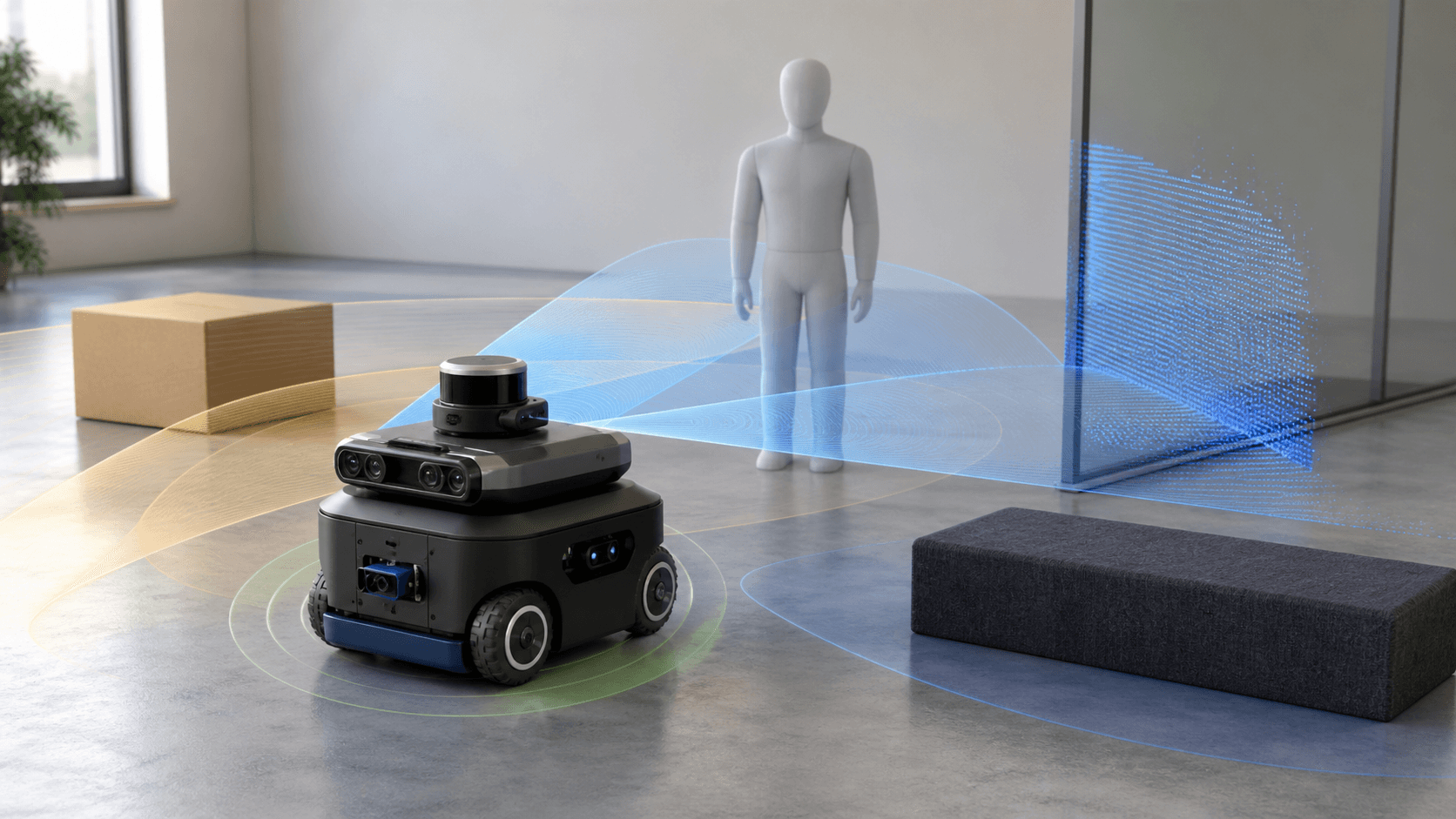
Different sensors measure different parts of a scene, while perception software builds the estimates a robot uses to act. AI-generated editorial illustration. It explains the concept and does not depict documented evidence.
1. In one sentence
Robot sensing measures the machine and its surroundings, while perception turns those imperfect measurements into estimates that can guide physical action.
2. Why you need to understand it
When a company says a robot can “see,” the word hides several steps. A camera records patterns of light. A depth sensor estimates distance. Software may then identify a pallet, locate a handle or mark floor space as occupied. None of those outputs is the physical world itself.
This distinction matters because robot behavior depends on estimates that can be incomplete or wrong. A human may instantly recognize a transparent door, but a range sensor may receive a weak or misleading return. A vision model may label an object correctly but estimate its position poorly. A mobile robot can know that a person is nearby yet still lack a reliable prediction of where that person will move next.
Readers who understand the path from measurement to estimate can assess product claims more precisely. Ask which sensors were used, what the software inferred, under which conditions it worked, how uncertainty was handled and what happened when one signal failed.
3. The core idea
A sensor converts a physical quantity into data. A camera measures incoming light. A wheel encoder measures rotation. An inertial measurement unit, or IMU, measures acceleration and rotational motion. A force–torque sensor measures loads at a joint or tool. LiDAR measures distance by timing reflected laser light, while tactile sensors measure contact at a surface.
Robotics commonly separates these measurements into two broad groups. Proprioceptive sensors measure the robot’s own state, such as joint angle, wheel motion or body acceleration. Exteroceptive sensors measure the external environment, such as nearby surfaces, objects, sound or contact. Karlsruhe Institute of Technology’s robotics curriculum uses this distinction and emphasizes that sensors also differ in range, resolution, accuracy and bandwidth.
Perception is the software process that interprets sensor data. It can estimate the robot’s position, identify objects, separate traversable floor from obstacles, calculate an object’s pose or detect contact. A pose is an estimate of position and orientation. Perception therefore produces a useful hypothesis about the world, not guaranteed truth.
Robots often combine several signals through sensor fusion. This means using measurements with different strengths to maintain one working estimate. Wheel encoders can track short-term movement but accumulate drift. An IMU responds quickly to motion but also develops error. A camera or map landmark can provide another reference. Combining them can improve the estimate, but only when timing, calibration and uncertainty are handled correctly.
4. How it works
Imagine a warehouse mobile robot carrying a tote toward a workstation while a person crosses its route.
- Collect measurements. Cameras, range sensors, wheel encoders and an IMU produce streams of data. Each stream has its own field of view, update rate and error pattern.
- Calibrate and align. Software accounts for where each sensor is mounted, converts readings into shared coordinate frames and matches measurements taken at different times.
- Extract useful features. Perception algorithms detect surfaces, motion, object boundaries or recognizable landmarks. Raw pixels and range returns become candidate observations.
- Estimate state. The system combines observations with a motion model to estimate the robot’s location, velocity and nearby occupied space. A motion model is a mathematical expectation of how the machine can move.
- Pass estimates and uncertainty to action software. Navigation uses the estimated free space and robot state to slow, stop or choose another route. New measurements then update the estimate as the scene changes.
The ROS robot_localization package provides a concrete example of state estimation. Its documentation describes filters that can combine multiple odometry, IMU, pose and velocity inputs. The filters predict how the state changes, then correct that prediction with sensor measurements. This does not make the estimate infallible: poor configuration, biased sensors or inconsistent uncertainty values can still produce unstable or misleading results.
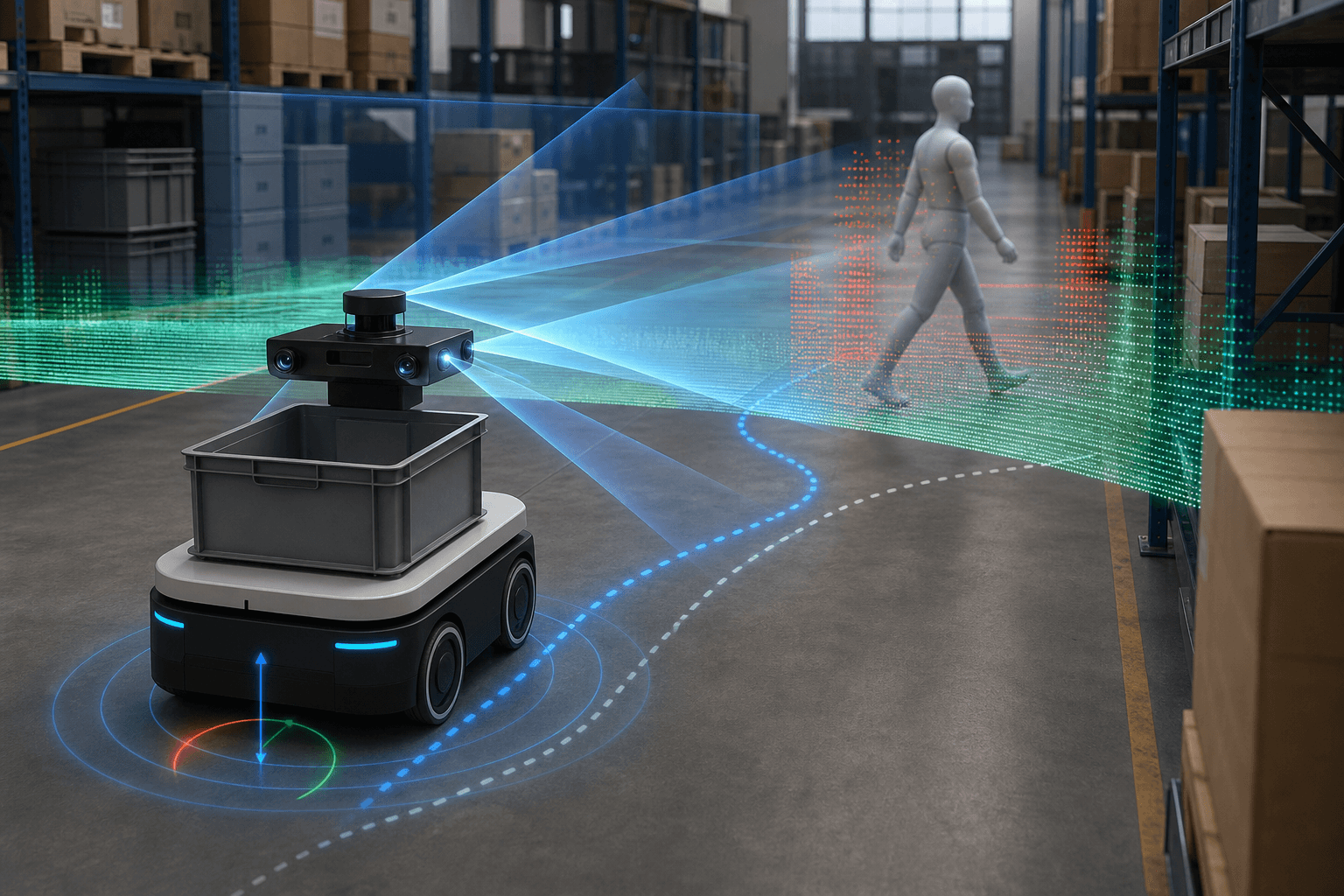
A robot aligns measurements from different sensors before using them to estimate its motion and surrounding space. AI-generated editorial illustration. It explains the concept and does not depict documented evidence.
5. A real-world example
Gen 3 Carter perception system — Announced commercial-development system. In June 2026, Aptiv announced that Robust AI had selected its PULSE perception technology for the Gen 3 Carter collaborative mobile robot. According to the two companies, the planned system combines surround-view vision with ultra-short-range radar and fuses raw detections to support depth maps and occupancy grids. An occupancy grid is a map-like estimate that divides nearby space into cells and assigns whether each cell appears free or occupied.
This is a useful example of complementary sensing. Cameras provide rich visual detail but can be affected by glare, darkness or low visual contrast. Radar measures reflected radio waves and can retain different strengths under dust, moisture or challenging illumination. Fusion does not mean one sensor “fixes” every weakness of the other; it means software can compare and combine their evidence.
The published capability descriptions are Company claim statements from Aptiv and Robust AI. The announcement said Aptiv would pursue Performance Level d certification for relevant safety uses; it did not establish that certification as already complete. The source also does not provide independent deployment results for the Gen 3 system. Its status should therefore be understood as an announced commercial-development integration, not independently verified fleet performance.
6. Common misunderstandings
“A camera sees what a person sees”
A camera records an array of light measurements from one viewpoint. Human-like interpretation is not contained in the pixels. Robot software must still estimate depth, separate objects, handle occlusion and decide which features matter for the task. A visually obvious object can remain operationally ambiguous.
“More sensors always make a robot safer and more reliable”
Additional sensors can provide coverage or redundancy, but they also introduce calibration, timing, computation and maintenance demands. If two sensors are misaligned or their uncertainty is modeled poorly, combining them can degrade an estimate instead of improving it.
“An object label is ground truth”
A perception model’s output is a prediction. A label such as “person” does not guarantee correct position, distance or future motion. Action software needs geometry, timing and uncertainty, not only a category name.
“If the robot sensed an obstacle once, it knows where it is”
People, carts and doors move. The robot itself changes viewpoint as it travels. Perception must update continuously, and old measurements can become unsafe assumptions.
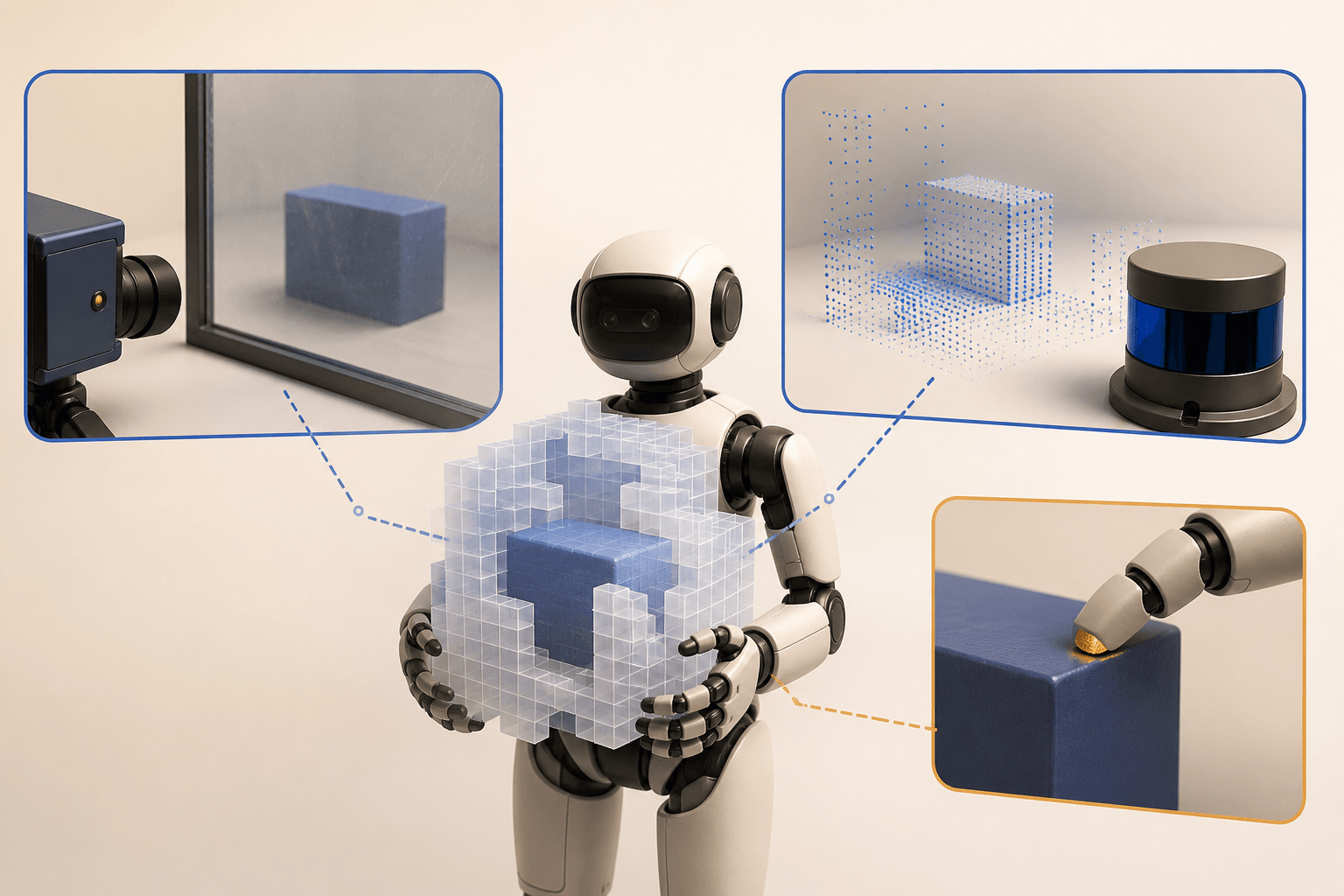
No single sensor provides complete understanding; each measurement has a field of view, resolution and failure pattern. AI-generated editorial illustration. It explains the concept and does not depict documented evidence.
7. Current limitations
Every sensor operates inside physical limits. Cameras lose information in darkness, glare or motion blur. Range sensors can struggle with transparent, reflective or absorbent materials. Encoders report motor or wheel motion but cannot directly prove that the robot moved as expected when a wheel slips. Tactile sensors provide valuable contact information only after interaction occurs.
Calibration can change over time because of vibration, impact, temperature or maintenance. Timing also matters: measurements collected milliseconds apart may describe different states of a fast-moving robot or person. Processing adds latency, so the best estimate available to a controller can already be slightly old.
Perception models inherit limits from their data and evaluation conditions. An object detector trained on familiar scenes may fail on unusual shapes, clutter or lighting. State estimators depend on assumptions about motion and measurement noise. When those assumptions break, a mathematically precise output can still describe the wrong situation.
Sensor fusion reduces some uncertainty but does not erase it. Several sensors may share a failure cause, such as blocked views or incorrect calibration. Safe systems therefore need conservative behavior, fault detection and clearly defined stopping or assistance rules in addition to capable perception.
8. Key takeaways
- Sensors measure physical quantities; perception software interprets those measurements.
- Proprioceptive sensors describe the robot’s own state, while exteroceptive sensors observe the surrounding environment.
- Sensor fusion combines complementary evidence, but calibration, timing and uncertainty determine whether the result is useful.
- A perception output is an estimate tied to conditions, not a direct copy of reality.
- Reliable action requires continuous updates and explicit behavior for uncertainty or sensor failure.
9. Where to go next
This is article 3 of the six-part Beginner guide path. Read What Makes a Machine a Robot? and What Is Embodied AI—and Why Does a Body Change the Problem? first for the category and system-level foundations. Continue with How Feedback Control Turns Robot Commands Into Reliable Motion, followed by How Robots Learn From Human Demonstrations and What Robot Autonomy Really Means as those guides are published.
10. Sources & evidence
- Robotics III: Sensors and Perception in Robotics — Karlsruhe Institute of Technology.
- CS227A: Robot Perception — Stanford University.
- robot_localization documentation — Robot Operating System documentation.
- State Estimation Nodes — Robot Operating System documentation.
- Robust AI Selects Aptiv Perception for its Gen 3 Carter Robot — Aptiv press release; product and performance statements are company claims.
Sources — How Robots Sense the World—and Why Sensing Is Not Understanding
Access date: September 2, 2026
1. Robotics III: Sensors and Perception in Robotics
- Institution: Karlsruhe Institute of Technology, Institute for Anthropomatics and Robotics
- URL: https://h2t.iar.kit.edu/1583.php
- Last changed: February 4, 2026
- Source type: University teaching material
- Supports: Sensation/perception distinction, sensor characteristics, proprioceptive and exteroceptive categories, vision, point-cloud processing, manipulation perception and SLAM.
2. CS227A: Robot Perception
- Institution: Stanford University School of Engineering
- URL: https://bulletin.stanford.edu/courses/2258812
- Publication date: Current course catalog; page does not state a separate publication date
- Source type: University course description
- Supports: Relationship among sensor hardware, processing algorithms, interpretation and actionable decisions.
3. robot_localization documentation
- Institution: Robot Operating System community documentation
- URL: https://docs.ros.org/en/noetic/api/robot_localization/html/index.html
- Publication date: Documentation for version 2.7.7; page does not state a date
- Source type: Technical documentation
- Supports: Nonlinear robot state estimation and fusion of multiple odometry, IMU, pose and velocity inputs.
4. State Estimation Nodes
- Institution: Robot Operating System community documentation
- URL: https://docs.ros.org/en/kinetic/api/robot_localization/html/state_estimation_nodes.html
- Publication date: Documentation page; date not stated
- Source type: Technical documentation
- Supports: Prediction-and-correction operation, motion models, coordinate frames, timing and configuration boundaries.
5. Robust AI Selects Aptiv Perception, Powered by PULSE, for its Gen 3 Carter Robot
- Institution: Aptiv
- URL: https://www.aptiv.com/en/newsroom/article/robust.ai-selects-aptiv-perception-powered-by-pulse-for-its-gen-3-carter-cobot
- Publication date: June 23, 2026
- Source type: Company press release
- Supports: Announced Gen 3 Carter integration, radar–vision fusion, depth-map and occupancy-grid claims, and planned PL(d) certification work.
- Attribution boundary: Product performance and intended safety benefits are company claims; the release does not provide independent fleet evidence.