
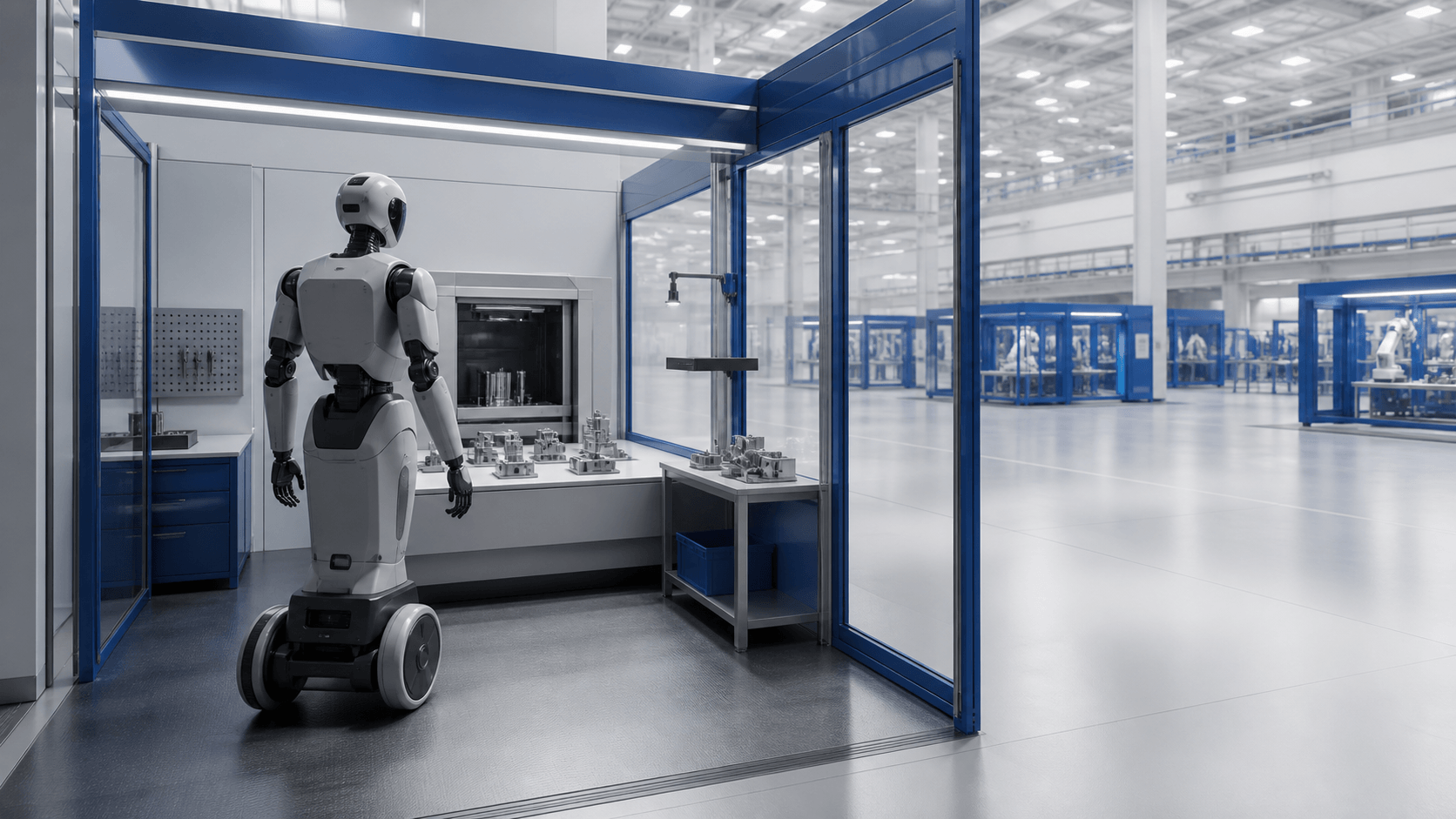
AI-generated editorial illustration. It does not depict a documented real-world event.
What happened
Hexagon Robotics and Schaeffler announced on August 19, 2026, that the AEON humanoid had entered Schaeffler’s Humanoid Gym in Germany. The facility is a dedicated industrial training and validation environment designed to prepare robot skills before they are introduced into operating factories.
The companies describe the process as “Train, Validate, Deploy.” AEON practices representative manufacturing tasks through imitation learning and repeated execution. Robot policies can be refined against factory-like workstations while Schaeffler employees build the knowledge needed to operate, train, integrate, and support the system.
This is a pre-deployment milestone. It is more substantial than a product demonstration because it links robot training to manufacturing applications. It is not evidence that the announced fleet has been deployed. Schaeffler’s separate April agreement states that the company plans to integrate at least 1,000 Hexagon humanoids into its global production network over seven years.
Confirmed facts
| Item | Confirmed detail |
|---|---|
| Milestone date | August 19, 2026 |
| Location | Schaeffler Humanoid Gym in Germany |
| Current activity | Training, testing, and validating AEON before factory deployment |
| Training method | Imitation learning and repeated execution on representative manufacturing applications |
| Partnership | Hexagon supplies the AEON platform; Schaeffler is both an intended user and actuator supplier |
| Scale target | Schaeffler plans at least 1,000 humanoids across its global production system within seven years |
| Earlier evidence | The companies report a 2025 pilot involving a multi-machine station |
| Near-term plan | Training is intended to support multiple Schaeffler manufacturing use cases over six months |
Schaeffler’s primary partnership announcement confirms that the cooperation includes development and supply of rotary actuators for humanoid joints. It also describes gradual integration into Schaeffler plants as a goal, not a completed fleet deployment.
Company context
Hexagon launched AEON in June 2025 as an industrial humanoid designed for manipulation, machine tending, inspection, reality capture, and operator support. The platform combines wheeled locomotion, sensors, spatial intelligence, AI-based mission control, teleoperation, and a battery-swapping system.
Schaeffler is unusually positioned in the partnership. It is a potential large-scale user of the robots and a supplier of components used in humanoid joints. Its actuator platform combines motors, power electronics, encoders, and planetary or strain-wave gearing. That dual role may shorten feedback between component design, robot behavior, and factory requirements.
The companies say a 2025 pilot demonstrated AEON loading, unloading, and inspecting parts at a multi-machine station. In April 2026 they expanded the relationship into a seven-year deployment plan, with further applications such as automated part inspection targeted from the end of 2026.
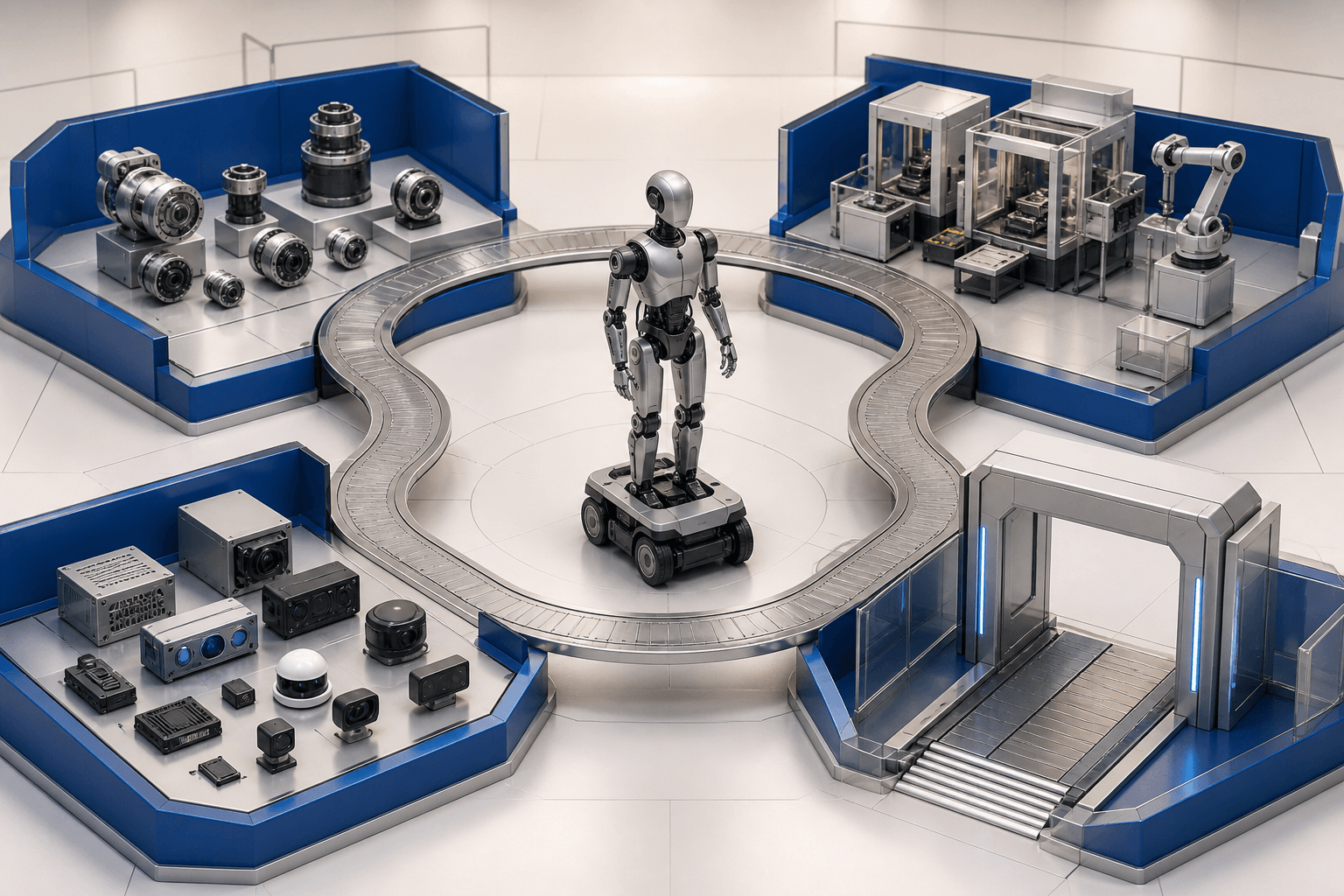
AI-generated editorial illustration. It does not depict a documented real-world event.
Why it matters
Industrial humanoids are often presented through short demonstrations that reveal little about repeatability. A training facility can address a different problem: converting an impressive motion into a qualified production process. A robot must perform the same task within tolerance, recover from variation, stop safely, interact with equipment, and remain supportable across shifts.
The gym also separates learning from live production. Policies can be trained and tested without interrupting an active line or exposing operators and equipment to an immature behavior. Representative workstations allow the partners to define task conditions before transferring a skill into a factory.
If the method works, it could become an operational bridge between a robot developer and a large manufacturer. The important innovation is not the word “gym.” It is the attempt to build a repeatable system for choosing tasks, collecting demonstrations, training policies, setting acceptance criteria, and transferring approved capabilities into production.
Claims versus evidence
Company claim: Hexagon and Schaeffler say the gym will accelerate deployment across multiple manufacturing use cases and support a rollout of at least 1,000 AEON humanoids. They present the partnership as a route to scalable industrial adoption.
Public evidence: AEON is in a named pre-deployment facility. The partners describe the training method, representative workstations, earlier pilot tasks, actuator supply relationship, seven-year horizon, and intended use in Schaeffler’s production network.
Evidence limit: The announcements do not disclose how many AEON units are in the gym, which tasks are currently being trained, the performance thresholds required for approval, or how many robots are operating on Schaeffler production lines. The 1,000-unit figure is a plan. It should not be reported as an order already delivered or as 1,000 completed deployments.
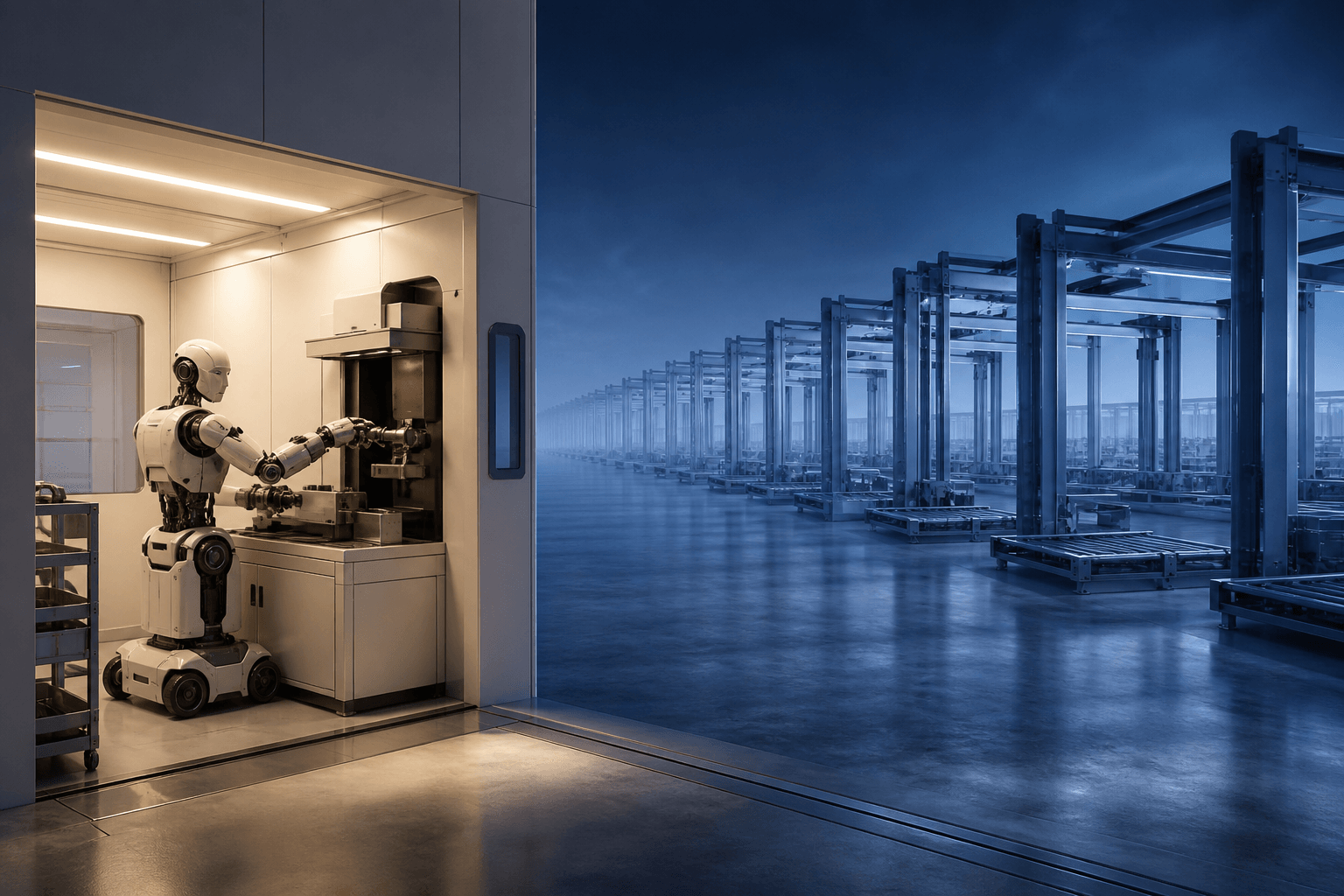
AI-generated editorial illustration. It does not depict a documented real-world event.
What remains unknown
- The number and configuration of AEON robots currently training in the facility.
- The exact manufacturing tasks included in the six-month program.
- Task-level success rate, cycle time, intervention rate, uptime, and safety thresholds.
- Who decides that a policy is validated and what evidence is required for approval.
- The timetable, locations, and annual quantities within the seven-year rollout plan.
- Purchase, lease, service, maintenance, and software terms between the companies.
- Whether the 1,000-unit plan constitutes a binding minimum order or a deployment objective subject to performance.
- How actuator supply economics interact with Schaeffler’s role as a robot customer.
Editorial analysis
The Humanoid Gym is meaningful because it acknowledges that industrial deployment is a process, not a launch event. The partners are building an intermediate layer between demonstration and production. That is precisely where many humanoid programs lack public detail.
But the structure should be judged by its outputs. A training facility can generate videos and policies without producing a factory-qualified task. The decisive evidence will be a progression from named workstation to acceptance threshold, production transfer, sustained operating hours, and replication at another plant.
The 1,000-robot plan gives the work strategic weight, yet it also raises the evidentiary standard. The next useful update is not another statement of scale. It is the first disclosed task that graduates from the gym into normal Schaeffler production, along with enough operating data to show why it passed.
Related company, robot, and technology
- Companies: Hexagon Robotics and Schaeffler — robot developer, intended industrial user, and actuator supplier.
- Robot: AEON — wheeled industrial humanoid designed for manipulation, inspection, reality capture, and machine-related tasks.
- Technology: Imitation learning, robot-policy validation, sensor fusion, spatial intelligence, teleoperation, battery swapping, and humanoid actuators.
Sources & evidence
- Towards factory deployment: How AEON is trained to perform — Hexagon and Schaeffler; primary joint announcement; August 19, 2026; accessed September 2, 2026.
- Humanoid robotics: Schaeffler enters into strategic partnership with Hexagon Robotics — Schaeffler; primary partner announcement; April 22, 2026; accessed September 2, 2026.
- Hexagon and Schaeffler to deploy a fleet of AEON humanoids — Hexagon and Schaeffler; primary joint announcement; April 22, 2026; accessed September 2, 2026.
- Hexagon AEON Enters Schaeffler’s Humanoid Gym for 1,000-Unit Push — Humanoid Intel; secondary analysis; August 19, 2026; accessed September 2, 2026.
Sources — AEON at Schaeffler’s Humanoid Gym
Access date for all sources: 2026-09-02
Primary sources
Towards factory deployment: How AEON is trained to perform
- Publisher: Hexagon Robotics and Schaeffler
- URL: https://hexagon.com/company/newsroom/press-releases/2026/towards-factory-deployment-how-aeon-is-trained-to-perform
- Publication date: 2026-08-19
- Source type: Joint company announcement; primary
- Supports: AEON’s entry into the German Humanoid Gym, Train–Validate–Deploy framework, imitation learning, representative workstations, six-month use-case plan, partnership roles, and connection to the 1,000-unit rollout objective.
- Evidence caution: Future deployment effects, performance improvements, and scalability are participant claims.
Humanoid robotics: Schaeffler enters into strategic partnership with Hexagon Robotics
- Publisher: Schaeffler AG
- URL: https://www.schaeffler.com/en/media/press-releases/press-releases-detail.jsp?id=88184987
- Publication date: 2026-04-22
- Source type: Partner announcement; primary
- Supports: Seven-year plan for at least 1,000 humanoids, actuator development and supply agreement, Schaeffler’s user-and-supplier role, and gradual integration objective.
- Evidence caution: The release includes forward-looking statements and does not document completed delivery at the stated scale.
Hexagon and Schaeffler to deploy a fleet of AEON humanoids
- Publisher: Hexagon Robotics and Schaeffler
- URL: https://hexagon.com/company/newsroom/press-releases/2026/hexagon-schaeffler-deploy-aeon-humanoids-across-global-factory-network
- Publication date: 2026-04-22
- Source type: Joint company announcement; primary
- Supports: Earlier pilot description, seven-year rollout plan, targeted additional applications, and actuator relationship.
Secondary source
Hexagon AEON Enters Schaeffler’s Humanoid Gym for 1,000-Unit Push
- Publisher: Humanoid Intel
- URL: https://humanoidintel.ai/news/hexagon-aeon-schaeffler-humanoid-gym-training-2026/
- Publication date: 2026-08-19
- Source type: Secondary analysis
- Supports: Independent framing of the gym as a pre-deployment milestone and explicit separation of current training from the future 1,000-unit target.